Chapter, the Asian fronts
Wartime India and Burma, the Burma Campaign and the War in China
Far from Europe's headlines, British, Indian and Chinese forces fought Japan across jungle, mountain and river. Feliks Topolski travelled through India and Burma into China as a war artist and drew what he saw on the way.
Published
Imphal and Kohima figures, the Kohima Museum, Gross and Life 1945 details checked on
- Years
- 1944 to 1945
- Places
- India, the Burma front, China
- His role
- Official war artist
- Published
- Three Continents, 1944 to 1945
Wartime India and Burma against Japan
Wartime India and Burma formed one of the largest and least visible theatres of the Second World War. After Japan entered the war in December 1941 it moved through Malaya, Singapore and Burma at speed, and by the spring of 1942 its army stood on the Indian border. Britain’s position in Asia had collapsed in a matter of months. India became the base from which a counter-offensive had to be built, with its railways, ports, hospitals and training camps all turned to the task, and the fighting itself took place in the hills and river valleys of Assam and Burma.
Anyone covering wartime India and Burma entered a different world from London. Distances were enormous. Supply lines ran over mountains and through forest, monsoon rains lasted for months, and disease killed and disabled more soldiers than bullets in many units. Most of the men were from the Indian Army, alongside British regiments, West and East African troops, Gurkhas and others. The fighting was often at close range in jungle, and journalists tended to arrive late and leave early because the terrain was so hard to cross.
Feliks Topolski came to this theatre in the later stages of his war. According to the standard accounts of his career, he sailed from Britain to Egypt, visited the Levant, and then travelled on to India, Burma and China. His drawings of the Asian journey were later gathered, with others from the same period, in a book called Three Continents, which covers 1944 and 1945 and came out in 1946. Because the dated detail of his movements is thin in public sources, the account below stays with what is documented about the war around him.
Key dates in India, Burma and China
| Date | What happened |
|---|---|
| 7 Jul 1937 | Marco Polo Bridge incident: full-scale war between Japan and China begins |
| 8 Dec 1941 | Japan attacks Malaya and Hong Kong |
| May 1942 | The British retreat from Burma reaches India |
| Early 1943 | First Arakan campaign; Anthony Gross draws at the front |
| Oct 1943 | William Slim takes command of the Fourteenth Army |
| 8 Mar - 18 Jul 1944 | Battles of Imphal and Kohima, the turning point in Burma |
| 5 - 18 Apr 1944 | Siege of Kohima, ended by the British 2nd Division |
| 22 Jun 1944 | IV Corps at Imphal links up with XXXIII Corps |
| Apr - Dec 1944 | Operation Ichigo across Henan, Hunan and Guangxi |
| 19 Mar 1945 | Life prints Topolski's sketches from India and China |
| 20 Mar 1945 | Mandalay retaken |
| May 1945 | Rangoon retaken |
| 1946 | Three Continents 1944-45 is published |
The Burma campaign as it looked in 1944
The Burma campaign reached its decisive point in 1944. In the spring, Japanese forces attacked across the frontier towards Imphal and Kohima, hoping to break the British position in north-east India. The garrisons held through weeks of siege and hard fighting, supplied in part from the air, and by the summer the Japanese army was in retreat with heavy losses. It was a major defeat for Japan, and it opened the way for the Fourteenth Army, commanded by General William Slim, to advance back into Burma.


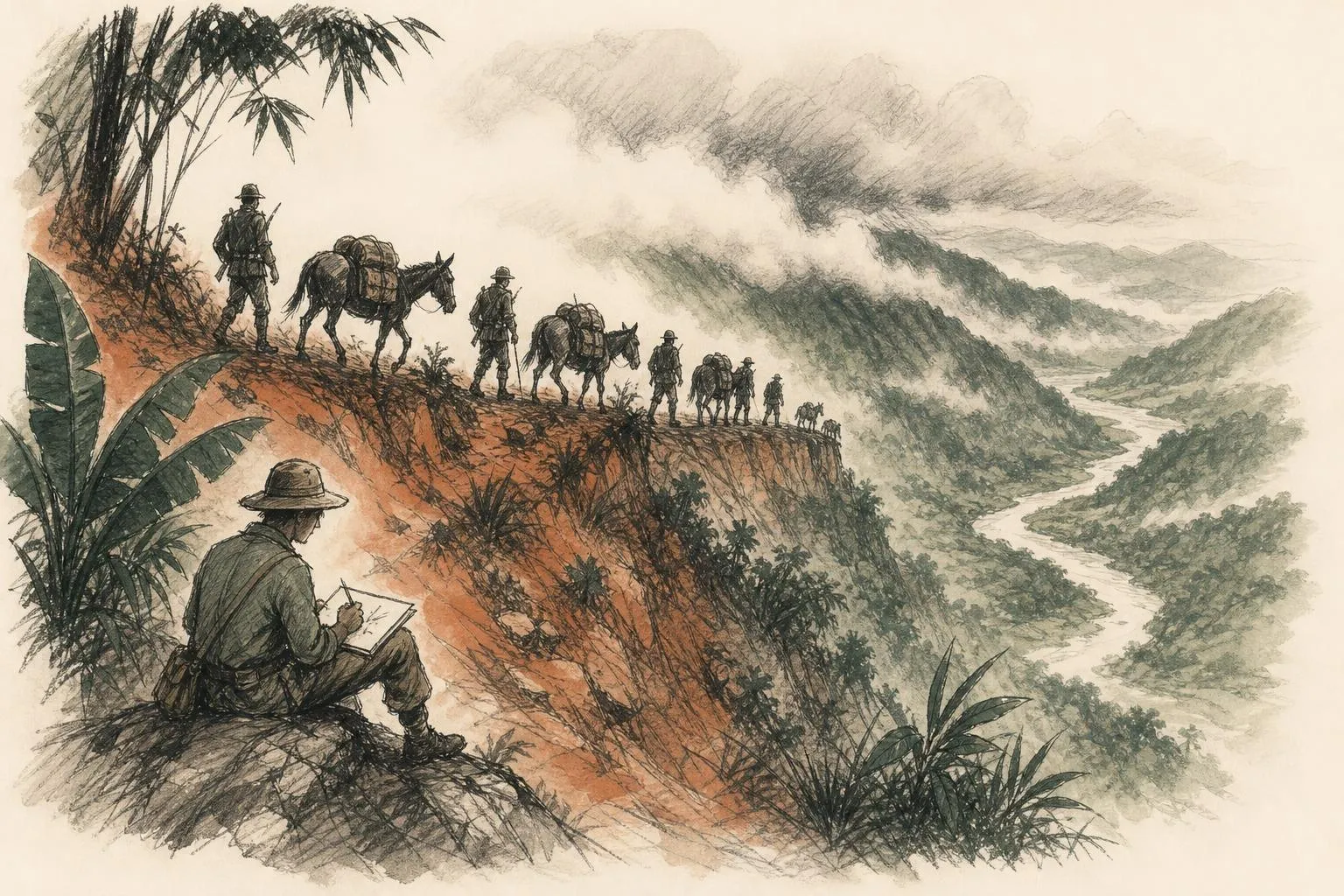
The campaign was also a story of engineering and logistics. The Ledo Road was cut through jungle to link India with the old Burma Road, so that supplies could reach China overland, and aircraft flew the mountain route that crews called the Hump. A war artist could draw those things as readily as a firefight: mule trains on narrow tracks, bridge-building on swollen rivers, field hospitals under canvas, men washing in streams between patrols.
Public attention at home was divided. The invasion of Normandy in June 1944 took the front pages, and the troops in Burma began to describe themselves as the Forgotten Army. That sense of neglect is one reason pictures from the front carry weight. A drawing from the Burma campaign was, for the artist and for some readers, a way of saying that these men and their war existed.
Imphal and Kohima in numbers
The National Army Museum dates the battles from 8 March to 18 July 1944. The Japanese Fifteenth Army went in about 85,000 strong and lost some 53,000 dead and missing. At Kohima, a garrison of about 2,500 faced around 15,000 Japanese troops, and the siege lasted from 5 to 18 April, when the British 2nd Division broke through. At one point only the width of the tennis court beside the Deputy Commissioner’s bungalow separated the two sides. Fighting around Kohima went on until 22 June, the day IV Corps, cut off at Imphal since early April, linked up with XXXIII Corps on the road. The museum puts British and Indian casualties at about 12,500 at Imphal and 4,000 at Kohima.
The 2nd Division’s memorial at Kohima carries the lines by John Maxwell Edmonds now known as the Kohima Epitaph: “When You Go Home, Tell Them of Us and Say, For Your Tomorrow, We Gave Our Today.” In Britain, the Kohima Museum in Imphal Barracks, York, began with the 2nd Division and the battle and now covers the whole Burma campaign; it describes itself as the only UK museum devoted entirely to it. It opens on Thursday mornings, other visits are by arrangement with the curator, and you need photo ID to get into the barracks.
China under Japanese invasion
China had been at war with Japan since 1937, long before the conflict spread across the world. By the time Topolski crossed into the country, the war had been running for seven years. The capital had moved inland to Chongqing, large areas of the coast and the Yangtze valley were under Japanese occupation, and the government of Chiang Kai-shek relied on supplies flown in from India. Millions of people had been displaced.


The year 1944 brought a fresh blow. Japanese armies launched Operation Ichigo, a huge offensive that pushed south and west through Henan, Hunan and Guangxi, capturing the airfields that American aircraft used and seizing the railway that ran from north to south. Refugees filled the roads. For a reportage artist, the new arrivals, the carts, the hand-carried bundles and the soldiers waiting at crossroads made a subject that needed no arrangement.
Those scenes are the reason China features so strongly in how Topolski’s war is remembered. A contemporary American magazine, Life, printed a photo-story built from his China sketches that dealt with refugees on the road and with soldiers, and the pages show how directly his drawing could be fitted to a magazine layout. The feature ran in the issue of 19 March 1945 and went well beyond China, with Rajput troops at Jaipur, Gandhi on a beach, Muhammad Ali Jinnah at home and a prosperous bather in the steam baths of Chongqing. He would return to China in 1966, at the opening of the Cultural Revolution, and the 1940s visit is the first of the two trips.
How a war artist worked on the Asian fronts
The conditions of this journey shaped the style of the drawings. Humidity swelled paper and ran ink. Rain meant long stretches when nothing could be drawn outdoors. Transport was a matter of waiting for a seat on an aircraft or a lift on a lorry, so the artist often had to work from the little that he could see in an hour at a stopping place. The result was a series of sheets that favour groups and gesture over detail: a crowd in a market, a line of men in a doorway, a face seen from the side.
Topolski also worked, as he did throughout the war, as a witness more than as an illustrator of operations. His official status gave him access, but the choice of subject was his, and many of the sheets deal with the people around the army rather than the army itself. This is a defining habit of the reportage tradition, and it is explained in more general terms on the page about reportage drawing.
For readers who want to place the journey in his life, the artist biography gives the outline from Warsaw in 1907 to the long panorama he began in 1975, and the memoir index shows the full run of periods. His return to India after independence, at Nehru’s invitation around 1949-50, is treated in a separate chapter on post-independence India.
Other British war artists in Burma
Topolski was not the first artist sent to this front. Anthony Gross went to India and Burma in 1943 and reached the lines of the first Arakan campaign. His ink wash of men of the 7th Rajput Regiment resting on South Hill, now at Imperial War Museums (ART LD 3334), shows soldiers at ease beside two parasols that, according to his diary, a night patrol had carried back from a village held by Japanese troops. Gross was sent to show British and Indian commitment to the region. Set beside his sheets, Topolski’s Asian drawings sit further from the front line, among princely courts, markets, bathhouses and roads.
Before and after this chapter
The previous chapter, on the London Blitz, covers the opening years of the war at home and the start of Topolski’s work as a war artist. The next one, on the last year of the war, follows the end of the conflict in Italy and Germany. Taken together the three show how far one commission could stretch: from a bombed Soho street to a mountain track on the Burmese frontier and back across the world to a defeated Germany.
If you want to try a version of this in your own sketchbook, the practical lesson from the Asian fronts is to plan for the weather. Carry a waterproof pen, use thicker paper than you would indoors, and keep the first drawing of any scene small and quick. Rain, heat or a crowd can end a session after five minutes, and a small sheet that is finished beats a large one that is not.
FAQ
Questions, answered
01Did Feliks Topolski draw on the Burma front itself?
Accounts of his wartime travels place him on the Burma front during his Asian journey, and one report says he crossed into China from Burma. The exact dates and units are not well documented in popular sources, so the dated detail on this page is kept to what can be checked.
02Why is the Burma campaign called the forgotten war?
British, Indian, African and Allied troops fought in Burma from 1942 to 1945 against Japanese forces, but the campaign attracted far less press attention at home than the war in Europe. Soldiers of the Fourteenth Army took the nickname the Forgotten Army because of that gap.
03What was happening in China while he was there?
China had been at war with Japan since 1937. In 1944 Japanese forces launched a large offensive, known as Operation Ichigo, that overran airfields and rail lines in the south and centre of the country. Millions of civilians were displaced, and refugees on the roads became a common subject for visitors.
04Where does this chapter sit in the wartime sequence?
It follows the Blitz and Russia, and comes before the last year of the war in Italy and Germany. Topolski's Asian journey belongs to the period from 1944 into 1945, and drawings from it were collected in the book Three Continents.
05What is the Kohima Epitaph?
It is the inscription on the British 2nd Division's memorial at Kohima, lines by John Maxwell Edmonds: 'When You Go Home, Tell Them of Us and Say, For Your Tomorrow, We Gave Our Today.' The siege it commemorates, at Kohima from 5 to 18 April 1944, was part of the Imphal and Kohima battles that turned the war in Burma against Japan.
06Where can you learn about the Burma campaign in the UK?
The Kohima Museum in Imphal Barracks, York, is devoted to the Burma campaign. It opens on Thursday mornings, other visits can be arranged with the curator, and you need photo ID to enter the barracks. Imperial War Museums hold war art from the front, including Anthony Gross's Arakan drawings of 1943. Check details on the museums' own sites before you travel.