Drawing the city
Drawing London: Crowds, Buses and the River in Urban Sketching
London moves faster than a pencil. This article explains how to draw crowds, buses and the tidal river without waiting for anything to stop, and names the places where the subjects come to you.
Published
Thames tides and foreshore rules, obstruction law, public space charter, Columbia Road hours checked on
- Best method
- Short timed gestures
- Kit
- Pocket pad, pencil, fineliner
- Good spots
- Bridges, bus stops, markets, riverside
- Thames tide
- Rises and falls over 7 m twice a day
- Frequent buses
- 5+ an hour on about 60% of routes
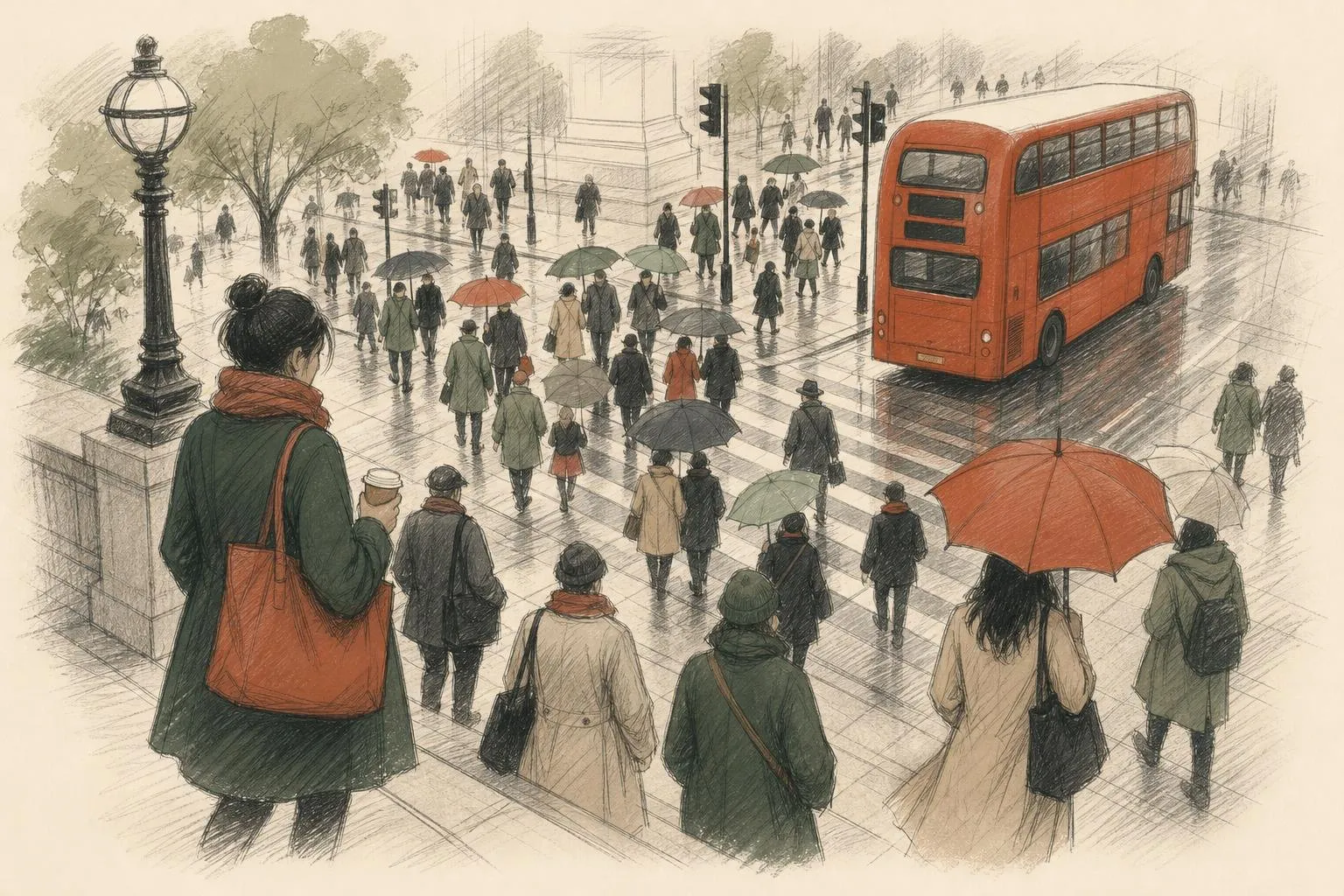
The first lesson of drawing London is that the subject will not wait. A figure walks out of frame in two seconds, a bus leaves the stop before the roof is down, and the river looks different every time you glance up from the page. People who start by trying to finish a drawing are often discouraged by it. The ones who last learn to draw the movement itself, in marks that are fast, approximate and honest, and to treat each page as a record of a few minutes of one afternoon.
This article is about that approach. It covers how to draw crowds, how to deal with buses and other vehicles, how to draw the Thames, and where in the city the subjects are friendliest to a person with a small pad.
Crowds: draw the pose, not the person
A crowd looks impossible until you notice how repetitive it is. People at a crossing or a bus stop hold only a few stances: weight on one leg, head down over a phone, arms folded, a bag pulled up on a shoulder. Each of these returns, often within a minute, with a different person wearing it. So you do not need to follow one individual. Start a figure, and when it leaves, start another in a different gap on the page.


Begin with the largest shape. A single line from head to feet carries the gesture of a standing person, and a rounded shape for the torso and another for the head are enough to place them in space. Details such as faces, hands and buttons can wait, or never arrive. A page of a dozen scribbled figures, varying in size and overlapping, reads as a crowd, which is the aim.
Sketching people on the train
Public transport is the gentlest way into sketching people in motion, because the passengers are hardly moving. A seated commuter on the Tube or the top deck of a bus often keeps one pose for several stops, long enough for the head, the shoulders and the angle of a phone. The carriage sways, so rest the side of your hand on the book and accept a wobbly line. Pick someone a few seats along, not directly opposite, since catching an eye across a carriage ends most sessions. When a face turns away, draw the shoes, the bag on the lap or the folded hands instead.
Ground and scale
Draw the ground line first, even if only as a few strokes, because it makes figures stand instead of float. Remember that heads in a distant crowd sit at roughly the same height as the horizon if you are at street level, and above it if you are higher. This one observation does more for believable crowds than any amount of anatomy.
Buses, taxis and other things that leave
London buses are a gift to drawers. They stop at regular points, wait long enough for a first pass, and come back along the same route at predictable intervals. If one leaves with the drawing half done, wait for the next. On the busiest central routes the next bus is rarely far behind, and a stop served by several routes shortens the wait for a second model even further.
Treat a bus as a long box. Draw the nearer vertical edge, then the line of the roof, then the lower edge and the wheels, and only then the windows and the colour break between upper and lower decks. Foreshortening matters: a bus seen from the corner at a stop is shorter than you expect, and the front is broader than the side. A few quick studies of the same bus from the same spot teach more than one careful drawing.
Taxis, cyclists and delivery vans follow the same logic. Draw the blocks first, then the rhythm of the wheels. Moving traffic is best treated as a gesture, with a few lines for the direction of travel, and you can add a detail only when you can remember one.
Drawing London’s river and skyline
The Thames is the other half of drawing London, and it is a patient subject compared with the pavement. Water moves, but the banks, bridges and buildings do not, so draw the fixed structure first and then add the river as a set of horizontal marks. Notice that the water’s reflections are a broken, darker version of what stands above it. Leave most of it blank paper and suggest it with a few horizontal strokes.


Tide and weather change the scene. At low water the foreshore exposes stones and mud, and at high water the river fills the frame with light. The sky occupies half the page in many London views, so decide early how much to give it. A low horizon with a large sky suits the flat parts of the river, while a high horizon and a tight crop of buildings suit a view from a bridge.
Tides and the foreshore
The tide decides what is there to draw. According to the Port of London Authority, the Thames can rise and fall by more than seven metres twice a day, so a stretch of shingle drawn at low water may be under the river a few hours later. Walking on the foreshore needs no permit. Searching it in any way, from Teddington down to the Thames Barrier, does, and a sketcher who starts picking up finds has crossed that line. The PLA also warns that river stairs can be slippery and are not always maintained, and that the current is fast and the water cold. Look up the tide times on the PLA’s tidal information pages, sit within easy reach of the steps you came down, and climb back up as the water starts to return.
Where to go for urban sketching
Urban sketching is simply drawing on location, and London offers plenty of places that give you shelter, a seat and a flow of people. Some reliable ones are below.
- Bridges, such as the footbridge to Bankside or the river crossings near Waterloo, give a long view of the river and moving figures
- Bus stops on main roads offer vehicles and queues together
- Market lanes, including those near London Bridge, give dense crowds that move slowly because people stop to buy
- Station concourses supply constant motion, though many stations have their own rules about drawing, so look for signs
- Riverside benches give long views of walkers and skyline with a place to sit
- Columbia Road Flower Market in east London runs on Sundays only, from 8am until about 3pm, and its narrow street packs a slow crowd between the stalls
Galleries on the South Bank and along the river also make good bases; the free entrance halls of large museums, such as the Turbine Hall at Tate Modern, give you a crowd inside a sheltered space. The Tate Modern visitor guide describes it.
Choose a position with a wall behind you and a wide view in front. You stay out of the way, nobody reads over your shoulder, and the whole scene stays in view.
The London chapter of Urban Sketchers runs sketch walks that have long been free to join without membership, and it posts the dates on its blog. For urban sketching for beginners, a group walk solves the two hardest problems at once: where to stand, and the feeling of being watched while drawing alone. More on the movement and how it differs from reportage is in the reportage drawing guide.
Sketching people in public: the rules
Sketching from a public street needs no permission. What can cause trouble is where you stand. Under section 137 of the Highways Act 1980, a person who wilfully obstructs free passage along a highway without lawful authority or excuse commits an offence. A sketcher planted in the middle of a narrow pavement at rush hour is the one most likely to be asked to move, which is one more reason for the wall behind you.
Privately owned public spaces work differently. The squares around many new office and housing schemes belong to a private estate, and its security staff can set rules. The Mayor of London’s Public London Charter, adopted in October 2021, asks owners of new public spaces to commit to eight principles, among them public welcome and unrestricted use, through the legal agreement attached to planning permission. Its guidance names non-commercial photography, busking and picnics as uses that management plans should not normally restrict. Drawing is not listed, though a person with a notebook on a bench is quieter than any of them. Older spaces are not bound by the Charter, as their owners can only sign up voluntarily, so on an established private estate a guard’s request to move on is the end of the matter.
Indoors, stations and venues set their own policies. The guide to free museums in London lists what each major gallery allows, from pencils to pad sizes and stools.
Working like a reportage artist
The tradition behind this kind of work is reportage drawing, in which artists record events as they happen, often at speed and in difficult conditions, and finish the pieces afterwards. The practice grows from the same skill: looking hard, deciding what matters, and committing marks in seconds. The page on reportage drawing describes the method in more depth, and it is a useful source of habits to borrow, such as noting the date, the place and a few words beside each sketch.
A small notebook is the right tool, which is why the guide to a pocket sketchbook is a sensible companion read. Carry the kit it lists, add a waterproof pen for rainy days, and keep your drawings loose. Fast marks are more truthful than slow, anxious ones.
Next time you wait at a bus stop, draw the first three people you see in under a minute each.
FAQ
Questions, answered
01How do I draw people who keep moving?
Draw the pose a person returns to, not the one they are in. Commuters at a stop wait in a handful of stances, and each one repeats within a minute. Start with the head and one big gesture line, then let the figure go and start another. Many drawers keep four or five figures going on one page.
02Is it legal to sketch in public in London?
Drawing in public places is generally allowed, since people may be seen and sketched in a public street. The offence to avoid is obstruction: section 137 of the Highways Act 1980 covers anyone who wilfully blocks free passage along a highway. Some privately owned public spaces, stations and venues set their own rules, and signs or staff will say so. Be sensitive about children.
03What is urban sketching?
Urban sketching means drawing from direct observation on location, in streets, cafes and transport, usually in a small notebook and usually in a loose, quick style. It grew into an international community of drawers who share work, but you need no membership. A pad and a pencil are enough.
04How do I draw a bus?
Treat it as a box with wheels. Draw the near edge of the box first, then add the roofline, the window band and the wheels. A bus waits at a stop for long enough to get the main shape down, and the next one along the same route arrives soon after for a second go.
05Where in London is good for sketching crowds?
Places where people pause: bus stops, bridges, market lanes, pavement cafes and the benches along the river. Avoid doorways and narrow pavements at rush hour. A spot with a wall behind you and a wide view of the flow gives the best mix of safety and subject matter.
06Do I need a permit to draw on the Thames foreshore?
Not to walk and draw. The Port of London Authority requires a permit only for searching the foreshore in any way, from Teddington to the Thames Barrier, which covers mudlarking, digging and metal detecting. It warns that the river can rise and fall by more than seven metres twice a day, that the current is fast and cold, and that river stairs can be slippery and poorly maintained. Check the tide times first and stay close to the steps you came down.