Memoir chapter
Post-Independence India: Nehru, 1947 and the Road to the Republic
Four years after the war ended, Feliks Topolski returned to an India that had been free for barely two years. This chapter sets out what that country was living through, and what a reportage artist could record there.
Published
Constituent Assembly dates, 1951-52 electorate, the 1949-50 tour and the Nehru Centre checked on
- Independence
- 15 August 1947
- Republic Day
- 26 January 1950
- Visit
- Around 1949-50
- Painting for India
- The East 1948, Rashtrapati Bhavan
1947: independence and Partition
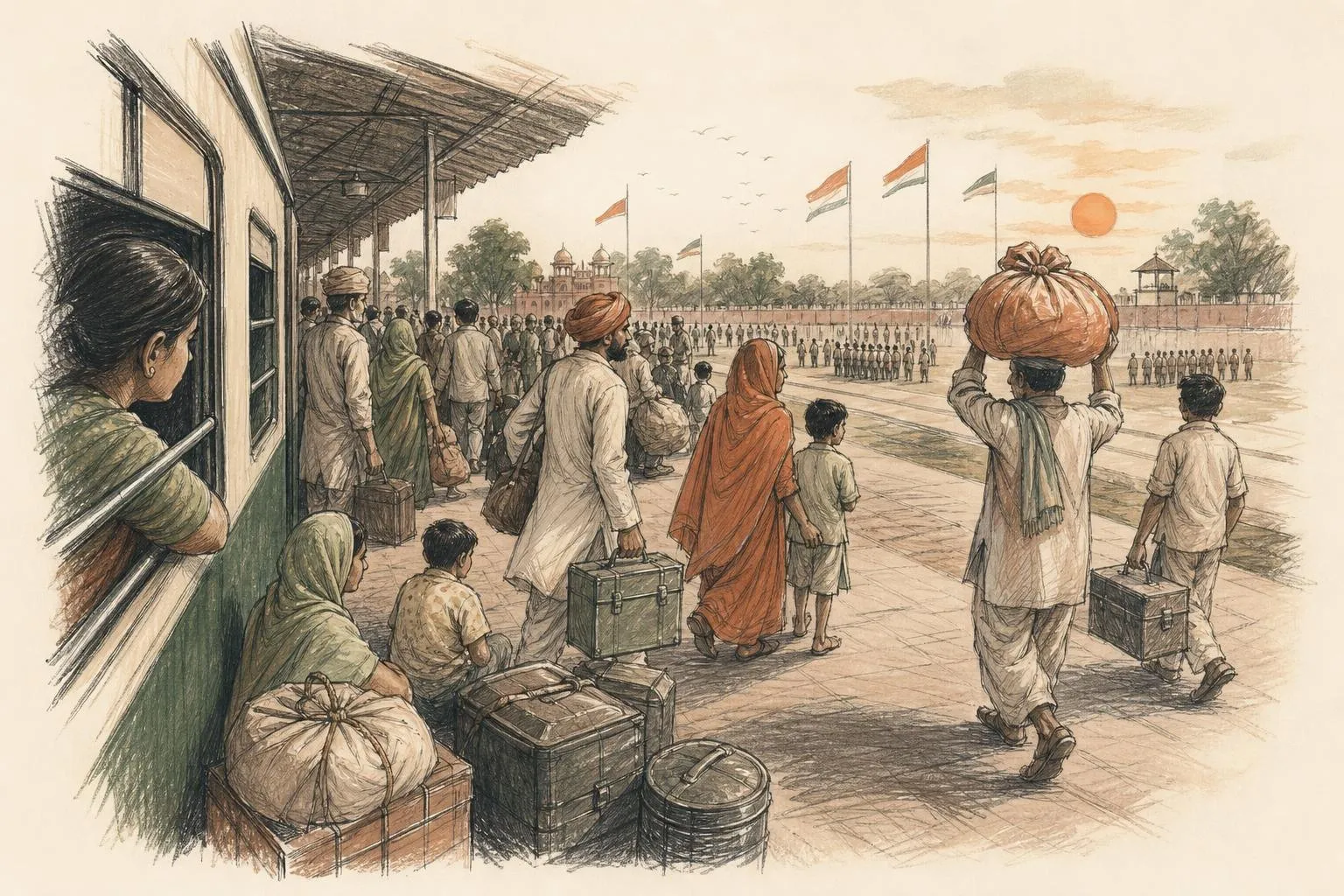
On 15 August 1947 British rule in India ended and the subcontinent became two states, India and Pakistan. The date is the hinge of post-independence India, but the celebration in Delhi, where Jawaharlal Nehru told the Constituent Assembly at midnight that the country was keeping a tryst with destiny, sat beside one of the largest forced migrations of the twentieth century. The new border had been drawn by a boundary commission under Sir Cyril Radcliffe and was published only two days after the transfer of power. Around fifteen million people crossed it in the following months, and estimates of the dead range from two hundred thousand to two million.
Nehru became the first prime minister and held the office until his death in 1964. Lord Mountbatten stayed on as governor-general until June 1948. The new government had to bring roughly 560 princely states into the union, fight a first war with Pakistan over Kashmir in 1947 and 1948, and house refugees in Delhi and across Punjab, all while a constitution was being drafted. On 30 January 1948 Mahatma Gandhi was shot dead at Birla House in Delhi. Muhammad Ali Jinnah, the founder of Pakistan, died in September of the same year.
Key dates of post-independence India
| Date | What happened |
|---|---|
| 9 Dec 1946 | The Constituent Assembly first meets in New Delhi |
| 18 Jul 1947 | Indian Independence Act receives Royal Assent |
| 14-15 Aug 1947 | Nehru's "Tryst with Destiny" speech at midnight; India becomes independent |
| 17 Aug 1947 | The Radcliffe boundary line is published |
| 29 Aug 1947 | Drafting Committee set up, chaired by B. R. Ambedkar |
| 30 Jan 1948 | Gandhi is assassinated at Birla House, Delhi |
| 21 Jun 1948 | Mountbatten leaves; C. Rajagopalachari becomes governor-general |
| 26 Nov 1949 | The Constitution of India is adopted |
| 26 Jan 1950 | First Republic Day: Rajendra Prasad becomes president, with Sukarno as chief guest |
| 1949 - 1950 | Topolski's tour: India, Burma, Indochina, Macao, Singapore, Japan, the United States |
| 1951 - 1952 | First general election, with an electorate of 173,212,343 |
Writing the constitution, 1946-1949
The constitution took almost three years to write. The Constituent Assembly first met in Constitution Hall, New Delhi, on 9 December 1946, before independence and before Partition changed its membership. On 29 August 1947, two weeks after the transfer of power, it set up a Drafting Committee chaired by B. R. Ambedkar, who took the text through the debates that followed. The final document was adopted on 26 November 1949, the date India now keeps as Constitution Day.
The republic’s first general election followed in 1951 and 1952. The Election Commission of India records an electorate of 173,212,343 for that vote.
Nehru and the road to the republic
The constitution was adopted on 26 November 1949 and came into force on 26 January 1950. The day was chosen on purpose: it was the anniversary of 26 January 1930, when the Indian National Congress first celebrated its declaration of complete independence. Rajendra Prasad took office as the first president, and the first Republic Day parade, held in Delhi that morning, had Indonesia’s president Sukarno as guest of honour. Nehru, still the dominant figure in the government, wanted the occasion to look outward as well as back.
It was in this setting that he invited Feliks Topolski to India. The artist had first seen the country during the Second World War, when he travelled as a British war artist, and he had met and drawn Gandhi then. The invitation asked him to join the celebrations of the republic, and a large four-panel painting with Gandhi at its centre, The East 1948, bought on India’s behalf in 1949 and now hanging in Rashtrapati Bhavan, belongs to the same story.
What Topolski saw on the return trip
A guest of the Indian prime minister in the early republic had an unusual vantage point. Public life then meant crowded platforms, receptions, village meetings, motorcades and long rail and road journeys, all of it moving fast and mostly in public. It is exactly the kind of material that suited a man who drew with a pen on whatever was in front of him, and it is the setting in which any drawings from the trip should be read.
The invitation also says something about his standing. A foreign artist asked to the capital by the head of government was being treated as a witness whose record mattered, and Topolski had already shown in wartime India that he would draw the people around the official events as readily as the officials.
The 1949-50 tour beyond India
India was the first stop of a longer journey. A biography published by the London dealer Chris Beetles describes an extended tour from 1949 into 1950 that took in India, Burma, Indochina, Macao, Singapore, Japan and the United States. It adds that he was often treated as a foreign dignitary, which opened doors to people and places that foreign journalists could not reach. That access fits the invitation from Nehru, and it fits the range of settings described above, from receptions to railway platforms.
Drawing a country in transition
A photographer in 1949 needed light, film and a clear line of sight. A reportage draughtsman needed a pen, a pad and a minute. The method, described in the guide to reportage drawing, is to catch the gesture first and the setting second, so that a handshake, a stance or the tilt of a head is down before the moment ends. For post-independence India, a country in the middle of reinventing itself, that suited the subject. Nothing stood still, and nobody posed.
The faces matter more than the buildings. In the India section of his huge Memoir of the Century panorama, Topolski put figures such as Nehru, Gandhi and Mountbatten, according to the Topolski Studio’s own description of the work. A painted panorama can hold people who never shared a room, and here it places the founders and the heirs of independence in one continuous scene. The method is explained further in the biography of the artist and in the overview of the memoir panorama.
From a war record to a peacetime one
The earlier chapters of the memoir follow the war: the London Blitz, the campaigns in India, Burma and China, and the camps and courtrooms covered in Belsen and Nuremberg. Post-independence India, in 1949 and 1950, is the first chapter where the subject is a state being built rather than a front being fought over. The drawing changes with it. There are fewer ruins and more ceremony, fewer soldiers and more administrators, and the sitters are looking back at the artist.
That shift carried into his later career. From 1953 he published his own Chronicle, turning travel and public events into broadsheets, and the habits formed on the Indian tour, working inside a moving official party and drawing at speed, ran through many later assignments. The next chapter in the sequence, on China and the Coronation, picks up that thread in 1953.
Nehru and India in London today
In Britain, the Nehru Centre on South Audley Street in Mayfair is the cultural wing of the High Commission of India in the UK. It was established in 1992 and calls itself the flagship overseas centre of the Indian Council for Cultural Relations, with exhibitions, lectures, illustrated talks, film screenings and music on its programme. Its listings are worth checking for talks on Indian history, and the guide to free museums in London covers galleries in the capital where you can sketch without paying.
If the subject is new to you, the quickest way in is to read a short account of the Partition and then look at a few reportage drawings from any period, noting what the artist chose to leave out. A single crowd scene drawn in ten minutes will teach you more about the method than a long description does.
FAQ
Questions, answered
01When did Feliks Topolski return to India after the war?
Accounts place the return around 1949 and 1950, after Jawaharlal Nehru invited him to India, in connection with the celebrations for the republic of 26 January 1950, though sources differ on the exact year. He had first visited the country as a war artist, so this was a second, very different trip, made in peacetime to a state that had been independent for little more than two years.
02Who did Topolski stay with in India?
Sources agree that he went at Nehru's invitation, and the Harry Ransom Center's account says he saw the end of the British Raj there. Detailed itineraries are thin, so the chapter stays with the setting: a young republic, a prime minister who wanted the occasion to look outward, and a visiting artist who drew what was in front of him.
03Why does the Partition matter to this chapter?
The Partition of 1947 is the background to every scene of the period. Millions crossed the new border, refugees filled northern cities and the new state was still settling. An artist arriving in 1949 drew faces and crowds that carried those events, even when the sketchbook showed a parade or a meeting.
04Did Topolski draw Gandhi and Jinnah?
Topolski made pencil sketches of Mahatma Gandhi on his earlier wartime visit, in 1944. A Life magazine feature of March 1945 also printed his sketch of Muhammad Ali Jinnah, made at Jinnah's home. Gandhi was dead by 1949, but he still shaped everything the artist saw on the return trip, and he is among the figures that the Topolski Studio lists in the Memoir of the Century.
05Where can you see this kind of reportage drawing today?
The Memoir of the Century panorama stands under the Hungerford Bridge arches on London's South Bank. For the method itself, a pocket sketchbook and a few hours at a station, market or public event are enough to start, and the reportage drawing guide on this site explains how.
06When did India hold its first general election?
The first general election was held over 1951 and 1952, under the constitution that had come into force on 26 January 1950. The Election Commission of India records an electorate of 173,212,343 for that election. Nehru, prime minister since independence, stayed in office after it and held the post until his death in 1964.