Chapter, wartime London
The London Blitz in 1940 and the War Artist Who Drew It
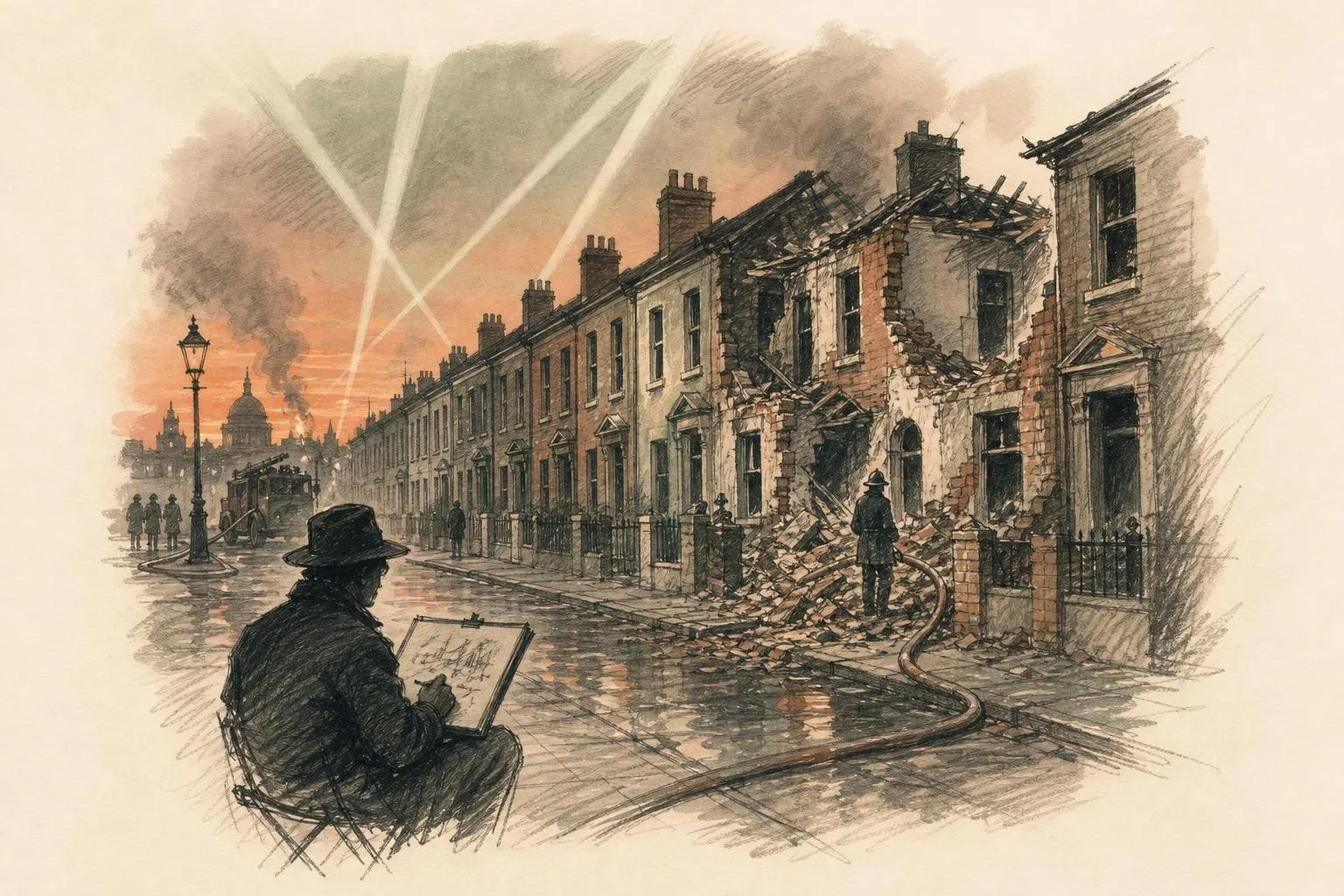
From September 1940 the capital was bombed on night after night. Among those who drew it was Feliks Topolski, a Polish-born war artist who worked on the pavements while the raids were still going on.
Published
Tube shelter figures, Blitz works in London collections and the 1941 Arctic voyage checked on
- Blitz began
- 7 September 1940
- Setting
- London, Soho and the East End
- His role
- Official war artist from 1940
- Injured
- May 1941, on duty as a war artist
Why the London Blitz mattered to an artist
The London Blitz was the German bombing campaign against Britain’s capital, and it changed what it meant to draw the city. It began on the afternoon of 7 September 1940, when a large force of bombers attacked the docks and the streets around them, and that night the fires could be seen from far away. London was then bombed on 57 consecutive nights, starting that night. By the time the heaviest attacks eased in May 1941, tens of thousands of civilians had been killed across Britain, and a large part of the East End, the City and the districts around the docks had been wrecked.
For anyone with a pencil the London Blitz was a strange situation. The subject was everywhere and it changed by the hour. A terrace that stood at breakfast could be a heap of brick by evening, and the people clearing it were visible, busy and mostly willing to be left alone. Britain already had a scheme for putting artists to work on the war. The War Artists’ Advisory Committee, set up at the start of the conflict under the director of the National Gallery, Kenneth Clark, commissioned painters and draughtsmen to record the home front, and many of the best known Blitz images came out of that system.
Feliks Topolski was one of the artists who found himself on that beat. Born in Warsaw in 1907, he had arrived in Britain in 1935 and was living in London when war broke out in 1939. Poland had been overrun within weeks by German and Soviet forces, and its government had gone into exile. The city he drew in 1940 was therefore also the city that had taken in the displaced political and cultural life of a country that no longer had its own government at home.
Key dates of the London Blitz
| Date | What happened |
|---|---|
| Nov 1939 | War Artists' Advisory Committee set up under Kenneth Clark |
| 7 Sep 1940 | "Black Saturday": the first mass raid on the docks and the East End |
| 7 Sep - 2 Nov 1940 | London bombed on 57 consecutive nights |
| 21 Sep 1940 | Around 120,000 people shelter in Underground stations |
| 14 Oct 1940 | Bomb above Balham station floods it; 64 killed by TfL's count |
| 29 Dec 1940 | Fire raid on the City, the "Second Great Fire of London" |
| 11 Jan 1941 | Direct hit on Bank station booking hall, 53 killed by TfL's count |
| 10-11 May 1941 | The last and heaviest major raid on London |
| May 1941 | Topolski wounded on duty as a war artist |
| 31 Aug 1941 | Topolski reaches Arkhangelsk with the first Arctic convoy |
| Sep 1940 - May 1941 | About 43,000 civilians killed across Britain, roughly half of them in London |
A war artist in 1940: rank and access
Topolski’s appointment as an official war artist dates from 1940. He worked for the British authorities and also for the Polish government in exile, which was led by General Władysław Sikorski and based in London. The arrangement mattered in practical terms. Official status brought him a uniform and permission to enter sites that were cordoned off to the public. It let him work more like a press photographer than a gallery painter, arriving quickly and leaving with a pile of sheets.
That speed shaped the work. Topolski’s method, which he kept for the rest of his career, relied on a fast, nervous line made with pen and ink. He drew standing up, or leaning on a wall, with the subject changing in front of him. The aim was not a composed picture but a record with energy in it: who was there, what they were doing, how the light fell on the broken fronts of the houses. Drawings of that kind were suited to print, and the later chapters show how his sheets were gathered into books.
The Blitz also gave reportage drawing a particular set of problems that are still familiar to anyone who sketches in public. Light failed early in winter. Blackout rules meant the streets were dark by the time a raid began. Crowds gathered around rescue sites and moved on as soon as they were told to. A war artist had to choose what to put down in the first minute and trust memory for the rest. The page on reportage drawing describes the same habits in a modern setting.
Drawn on the pavements and underground
The most famous Blitz drawings in British art are of the Underground. When bombing began, the authorities had first discouraged people from sheltering in the tube stations, but crowds simply bought platform tickets and went down anyway, and the policy was reversed. Every night thousands of people lay along platforms and in the tunnels, with blankets, flasks and children. Artists who visited the shelters found a subject that was dramatic without being violent, and a number of them produced large series.
Transport for London’s archive records around 120,000 people in the stations on 21 September 1940, and by October the count was 124,000, with 2,750 at King’s Cross alone. Facilities were thin at first: Holborn, which could hold 4,600 people, started with four chemical toilets and four buckets. Later came 24,000 bunks and a code of conduct asking shelterers to arrive after 6.30pm and leave by 7am. The deep stations were not always safe either. A bomb at Trafalgar Square on 12 October killed seven shelterers, and two nights later a bomb that fell above Balham flooded the station.


Above ground, the subjects were different. Firemen turned hoses on warehouses. Wardens worked through wrecked rooms with torches. Shopkeepers swept glass from the pavement and put up signs saying that business went on as usual. Churches and pubs were hit alongside factories and tenements, and the damage in the central districts was often strange to look at: a wall removed so that a staircase and a patterned wallpaper stood open to the street.


Soho was a district of small restaurants, studios, clubs and printers, and it was full of foreigners, many of them exiles. Topolski’s own war was not free of risk: in May 1941 he was wounded while on duty as a war artist, according to the Imperial War Museum. The detail is brief in the sources but it makes a plain point about the job. A drawing made at the spot is made at the spot’s risk, and the artist is not a spectator.
War artists of the Blitz and their work
Topolski was one of many war artists of the Blitz, and the best known of them worked very differently from him. Henry Moore went down into the stations under a commission from the War Artists’ Advisory Committee and made more than 300 drawings of sleeping shelterers between 1940 and the summer of 1941, according to the Henry Moore Foundation. The large sheets were worked up from his sketchbooks, in graphite, ink, wax crayon and watercolour. Leonard Rosoman, who served as a fireman in the Auxiliary Fire Service, painted the night of 29 to 30 December 1940 in Shoe Lane, in the City, when a burning building fell on two firemen; one of them was a young man who had just taken over from Rosoman.
Topolski’s Blitz drawings sit at the opposite end from Moore’s. His air-raid drawings of 1940 are quick and crowded with figures, closer to a newspaper report than to the slow, sculptural sheets Moore made in the tunnels.
Where to see Blitz art in London
| Collection | Blitz works |
|---|---|
| Imperial War Museum, Lambeth | Topolski's air-raid drawings, Rosoman's A House Collapsing on Two Firemen, Shoe Lane, shelter drawings by Moore |
| Tate Britain | Moore's shelter drawings, among them Tube Shelter Perspective (1941), given by the War Artists' Advisory Committee in 1946 |
| London Transport Museum, Covent Garden | Photographs and records of stations used as shelters |
Most of these works are drawings on paper, which museums rotate off display to protect them from light, so check the collection’s website for what is on show before you go. Tate Britain is one of the free museums in London, and the IWM catalogue can be searched online by artist.
Reading the Blitz through a reportage lens
The drawings from this period are worth looking at for what they leave out. They rarely show the dead. Wartime censorship, the habits of the commissioning bodies and the artists’ own tact all pushed in the same direction. What they show instead is people at work: the street that has to be cleared, the family that has to find somewhere to sleep, the shop that has to open. In that sense the Blitz drawings are an unusually clear example of how a reportage artist decides what counts as news.
Topolski’s own approach was to keep people at the centre. Buildings are present, but they are the setting, and the figures tend to carry the page. The same principle runs through his later work, from the war years abroad to the long panorama he began in 1975 under the arches near Hungerford Bridge, in which events of the century are told through crowds rather than monuments. The biography of the artist sets out that career in order, and the main memoir index lists every period he covered.
There is a limit to what a modern reader can take from reproductions. Many of the sheets were small and made quickly, and they were often reworked for publication. When you look at them in a museum, note the marks that look like the first pass: the thin outline, the place where the pen skipped, the figure left unfinished at the edge. Those are the traces of the moment of drawing.
From the Blitz to the fronts
The London Blitz had passed its peak by mid 1941. The weight of the German air campaign had shifted away from London, and Topolski’s work turned outward. Later that year he sailed from Liverpool aboard the Llanstephan Castle with the first Arctic convoy and reached Arkhangelsk at the end of August 1941. Accounts differ on the terms of the trip, and the convoy itself reached port without being attacked. Over the next four years his assignments took him across the Middle East, India, Burma and China before he ended the war in Germany. The next chapter in the sequence, on wartime India and Burma, picks up the story in Asia.
Practical notes for drawing a city under pressure
Few readers will draw a bombed street, but the habits of Blitz reporting carry over to an ordinary afternoon in a busy part of London. Work standing up, with a small sketchbook, so you can leave at once. Fix one shape in the first thirty seconds, usually the largest figure or the line of the roofs, and build around it. Leave out detail that the page cannot hold. Keep moving to a second position if a crowd gathers in front of you.
Two short guides on this site cover the equipment and the mindset: how to keep a pocket sketchbook, and how to approach drawing a city that won’t sit still. Soho is still a good place to try it.
FAQ
Questions, answered
01When did the London Blitz start and end?
The sustained bombing of London began on the afternoon of 7 September 1940 and continued for 57 consecutive nights. Heavy raids went on in waves until May 1941, and the last very large attack on the capital came on the night of 10 to 11 May 1941. Other British cities were bombed too, but London took the longest run.
02Was Feliks Topolski an official war artist during the Blitz?
Yes. He had settled in London in 1935, and from 1940 he worked as an official war artist. He was attached to both the British government and the Polish government in exile, and his official status helped him reach places that were closed to most civilians.
03What did a war artist actually draw in the Blitz?
Subjects ranged from collapsed buildings and rescue crews to people sleeping in shelters and Underground stations. Artists were encouraged to record ordinary wartime life as well as damage, so queues, factory work and the routine of a bombed city all appear in the drawings of the period.
04Where can you see Blitz drawings in London today?
The Imperial War Museum in Lambeth holds the largest body of official war art, including Topolski's air-raid drawings and Leonard Rosoman's painting of a collapsing house in Shoe Lane. Tate Britain holds a group of Henry Moore's shelter drawings. Only part of either collection is on show at any time, so check the museum's website before a visit.
05How many people sheltered in the Underground during the Blitz?
Transport for London's archive puts the figure at around 120,000 people on 21 September 1940, two weeks into the raids, and 124,000 in October. Across the whole war it estimates 63 million nights spent sheltering in tube stations. Some 24,000 bunks were eventually fitted, and the last night of sheltering was 6 May 1945.