Chapter, 1944 and 1945
The Last Year of the War, 1944 to 1945, Seen by a War Artist
In the final year of the war the Allied armies pushed through Italy and into Germany, while the Pacific and Asian fronts continued. Feliks Topolski, an official war artist, followed the story through several theatres.
Published
Monte Cassino dates and the Polish cemetery, VE Day in London checked on
- Years
- 1944 to 1945
- Fronts
- Italy, Germany, and earlier Asia
- His role
- Official war artist
- Book
- Three Continents
The last year of the war in outline
The last year of the war is a short phrase for a very crowded period. In the first half of 1944 the Allied armies in Italy were fighting for Rome, the Soviet Red Army was moving back through Ukraine and Belarus, and preparations for the landings in Normandy were nearing completion. Rome fell on 4 June 1944, and two days later British, American and Canadian troops went ashore in France. By the end of the summer Paris was free, and the front was approaching the German frontier.


The winter that followed brought a pause and then a final advance. The German offensive in the Ardennes, launched in December 1944, had failed by January, and in March 1945 Allied armies crossed the Rhine. American and Soviet forces met on the Elbe in late April. Hitler died on 30 April, Berlin surrendered in early May, and the unconditional surrender of Germany took effect on 8 May 1945. The war with Japan continued until August.
For a war artist this was the period when the story moved quickly and showed several faces at once. There were columns of vehicles and prisoners on the roads, ruined towns, liberated civilians, and soldiers who had come to expect an end but could not yet believe in it. The chapter on wartime India and Burma deals with the war in Asia in this same period, and what follows concerns Europe.
Key dates of the last year of the war
| Date | What happened |
|---|---|
| 17 Jan 1944 | First Allied assault on Monte Cassino |
| 15 Feb 1944 | The abbey on the hill is bombed |
| 11 May 1944 | Final offensive on the Gustav Line opens at 11pm |
| 18 May 1944 | Polish II Corps takes Monte Cassino; its flag is raised over the ruins |
| 4 Jun 1944 | Allied troops enter Rome |
| 6 Jun 1944 | D-Day landings in Normandy |
| 16 Dec 1944 | German offensive in the Ardennes begins |
| 7 - 23 Mar 1945 | Allied armies cross the Rhine |
| 21 Apr 1945 | Polish troops enter Bologna |
| 25 Apr 1945 | American and Soviet troops meet at Torgau on the Elbe |
| 8 May 1945 | VE Day: the German surrender, signed at Reims on 7 May, takes effect |
| 1946 | Three Continents, 1944-45 collects Topolski's drawings of the period |
Topolski in 1944-45: Italy to Germany
Feliks Topolski had begun the war as a London-based draughtsman and then become a travelling one. By 1944 he held an official post that took him far from Britain, and his journey over the next two years was gathered in the book Three Continents, which was published in 1946. The contents of that volume give a map of the route: a Mediterranean convoy, Egypt, East Africa, Palestine, Lebanon, Syria, Iraq, India, the Burma front, China, the Italian campaign, and finally a defeated Germany.
The Italian leg was the one most closely linked to Polish forces. Polish troops of the Second Corps, which had been formed from men who had been through Soviet camps and then moved through Iran and Iraq, fought in Italy from 1944. They became known for the capture of the ruins of Monte Cassino in May 1944, a costly battle after earlier Allied attacks had failed, and they entered Bologna in April 1945. Topolski had worked for the Polish government in exile during the war, and his access to the Polish units gave him a different vantage point from that of British correspondents.
He was also, by then, an experienced hand. Four years of drawing under fire, in cold and heat, had refined a method based on speed and economy. He drew quickly, and favoured groups and movement. The sheets show columns of men, civilians on the road and the ruined interiors of towns, rather than studied portraits. A reader who wants to see how the method developed can go back to the chapter on the London Blitz and compare the first wartime drawings with the later ones.
What the front looked like in Italy
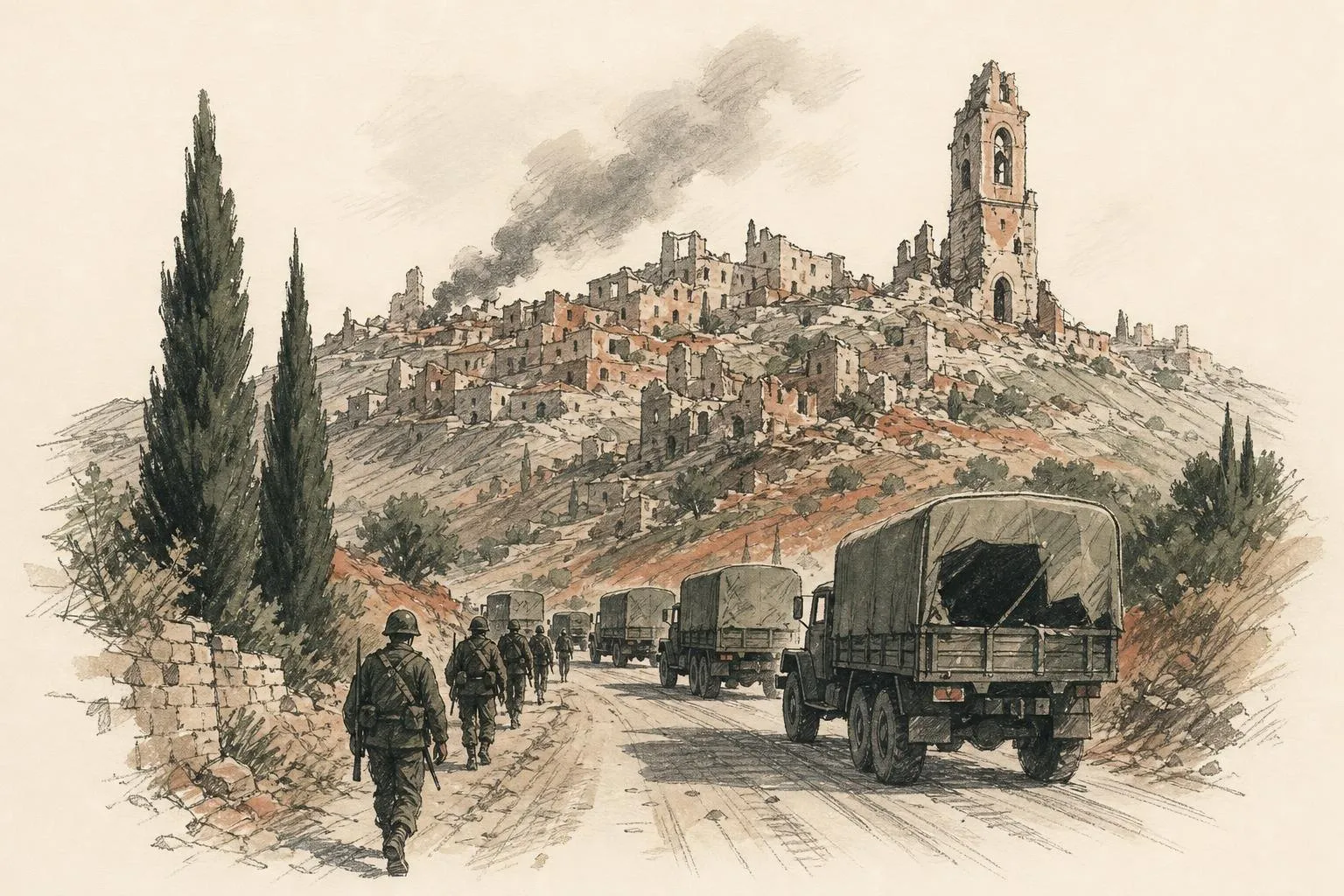
The Italian campaign was often a slow and unglamorous advance. The terrain, long ridges and river valleys running across the line of march, favoured the defenders, and the German army made use of every height. Towns that had stood for centuries were hit by artillery and aircraft, and civilians lived in cellars and caves. Armies pushed up the peninsula for almost two years.


In the last year of the war the Italian subject was rich in texture: stone villages with their roofs gone, mule trains, field kitchens, ambulances on narrow roads, people returning to houses without doors. The war was visible in the details of ordinary life. A drawing of a woman carrying water past a broken wall says as much about the fighting as one of a gun crew, and these are the pictures that reportage artists in the period tended to prefer.
The point about method is worth stating plainly. A war artist is not a camera, and the difference lies in the selection. A photographer records what is in front of the lens at the moment of the shutter. A draughtsman has several minutes, and decides which part of the scene is the story. The page on reportage drawing deals with the idea in general terms.
Monte Cassino and the Polish cemetery
Cassino took four battles. The first Allied assault went in on 17 January 1944, the abbey on the hill was bombed on 15 February, and a third attack followed in March. The final offensive on the Gustav Line opened at 11pm on 11 May with a huge artillery barrage. Polish II Corps, under General Władysław Anders, attacked the heights above the town, and on the morning of 18 May its flag went up over the ruins of the monastery, at about 10.20am by most accounts, with a British flag raised shortly after.
Losses were heavy. Published figures for the corps’ casualties in those attacks run to 281 officers and 3,503 other ranks. A Polish war cemetery was opened below the abbey in 1945, and the number of soldiers buried there is usually given as 1,072, although Italy’s tourism site counts 1,051 crosses. Anders, who died in London in 1970, is buried among his men. The song Red Poppies on Monte Cassino was written soon after the fighting by Feliks Konarski, who had been in the battle himself.
VE Day in London, 8 May 1945
The war in Europe ended for Londoners with a radio broadcast. Churchill spoke from Downing Street at 3pm on 8 May 1945, a day declared a national holiday, and also spoke to the crowd from the balcony of the Ministry of Health in Whitehall. The King broadcast to the country that evening. The royal family appeared on the balcony of Buckingham Palace eight times, almost 100,000 people gathered outside the palace and about 50,000 packed Piccadilly. Princesses Elizabeth and Margaret left the palace in secret to join the celebrations in the streets nearby.
The photograph of Whitehall near the top of this page shows that crowd. A victory crowd is hard to draw: hundreds of faces turned the same way, and no single event to hang the picture on. The same challenge comes back in the chapter on One Hundred Hippies, where Topolski drew London crowds of another kind.
The end of the war and the turn to the camps
The final stage of Topolski’s war took him into Germany. In April 1945 he reached Bergen-Belsen, two weeks after its liberation, attached to a Polish army unit, and the chapter on Belsen and Nuremberg deals with that visit and with the trials that followed. It is a different sort of subject from the campaign material, and it is treated there with the care it needs.
Taken in sequence, the chapters on the last year of the war and its neighbours give an outline of the war from the artist’s side. The Blitz covers the opening of the home front, the Asian chapter the war against Japan, this one the last campaigns in Europe, and the final war chapter the camp and the tribunal. After that the memoir index moves on to 1949 and the return to India, and the artist biography puts all of this in the frame of a longer life.
A note on looking at war drawings
Some of this material can be seen in London. Tate holds Topolski’s oil Germany Defeated, dated 1945 and acquired in 2016, and the Imperial War Museum holds his war drawings; the collections table in the artist biography lists both. When you see a drawing from this period in a museum or a book, check the caption for place and date before reading anything into it. Many sheets were made in the field, then reworked for publication, and some were retitled for the market. Look at the line itself. A confident outline usually means the artist had time. A broken, doubled line suggests that he was moving, or the subject was.
For a practical exercise, find a street with traffic and people and give yourself three minutes per drawing. Do five in a row, each from a different position, without correcting any of them. At the end, pick the one in which the most important thing is clear, and note what you left out. That choice is the whole craft of the reportage artist, and the simplest way to understand why these drawings still matter.
FAQ
Questions, answered
01What happened in the last year of the war in Europe?
In 1944 the Allies took Rome in June and landed in Normandy a few days later, then liberated France and Belgium. In early 1945 they crossed the Rhine and met Soviet forces on the Elbe. Germany surrendered unconditionally on 8 May 1945, a date marked as Victory in Europe Day.
02Which book collects Topolski's drawings from 1944 and 1945?
Three Continents, published in 1946, gathers material from that period. Its contents are described as covering England, a Mediterranean convoy, Egypt, East Africa, Palestine, Lebanon, Syria, Iraq, India, the Burma front, China, the Italian campaign and Germany defeated.
03Why did Polish forces matter in Italy?
The Polish II Corps fought in the Italian campaign, and its soldiers captured the ruins of Monte Cassino in May 1944 and entered Bologna in April 1945. For a Polish-born artist attached to Polish units, they were a natural subject.
04How did London celebrate VE Day in 1945?
Churchill announced the end of the war in Europe in a radio broadcast from Downing Street at 3pm on 8 May 1945, which was declared a national holiday. The royal family came out onto the Buckingham Palace balcony eight times, with almost 100,000 people outside the palace and about 50,000 in Piccadilly. Princesses Elizabeth and Margaret slipped out to join the crowds.
05Where does the chapter on Belsen and Nuremberg fit?
It follows directly. Belsen was reached in April 1945, in the last weeks of the war, and the Nuremberg trials began in November 1945, after it. This chapter covers the campaigns that led up to them, and the next covers the camp and the trials.