Sketchbook habits
How to Keep a Pocket Sketchbook: Build the Habit and Choose Your Kit
A pocket sketchbook works because it is always there. Here is the size, the kit and the small daily routine that turn a blank notebook into a record of what you have actually seen.
Published
Paper sizes, paper weights (Seawhite and Daler-Rowney on the makers' pages), bindings and pencil grades checked on
- Page size
- A6 (105 x 148 mm) or about 90 x 140 mm
- Sketch paper
- 100 to 165 gsm in pocket books
- Core kit
- 2B pencil, pigment fineliner, small rubber
- Time per day
- Five to ten minutes
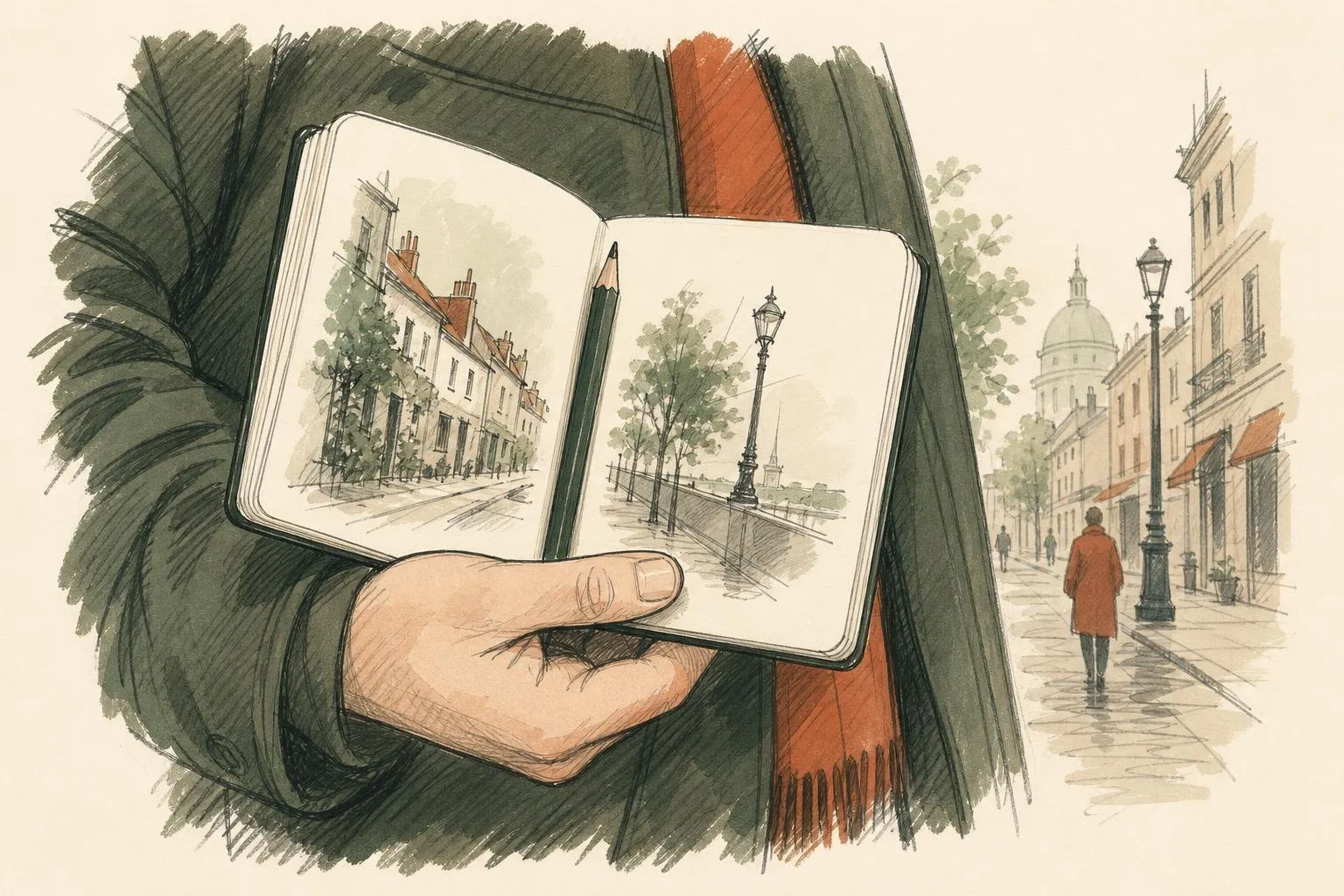
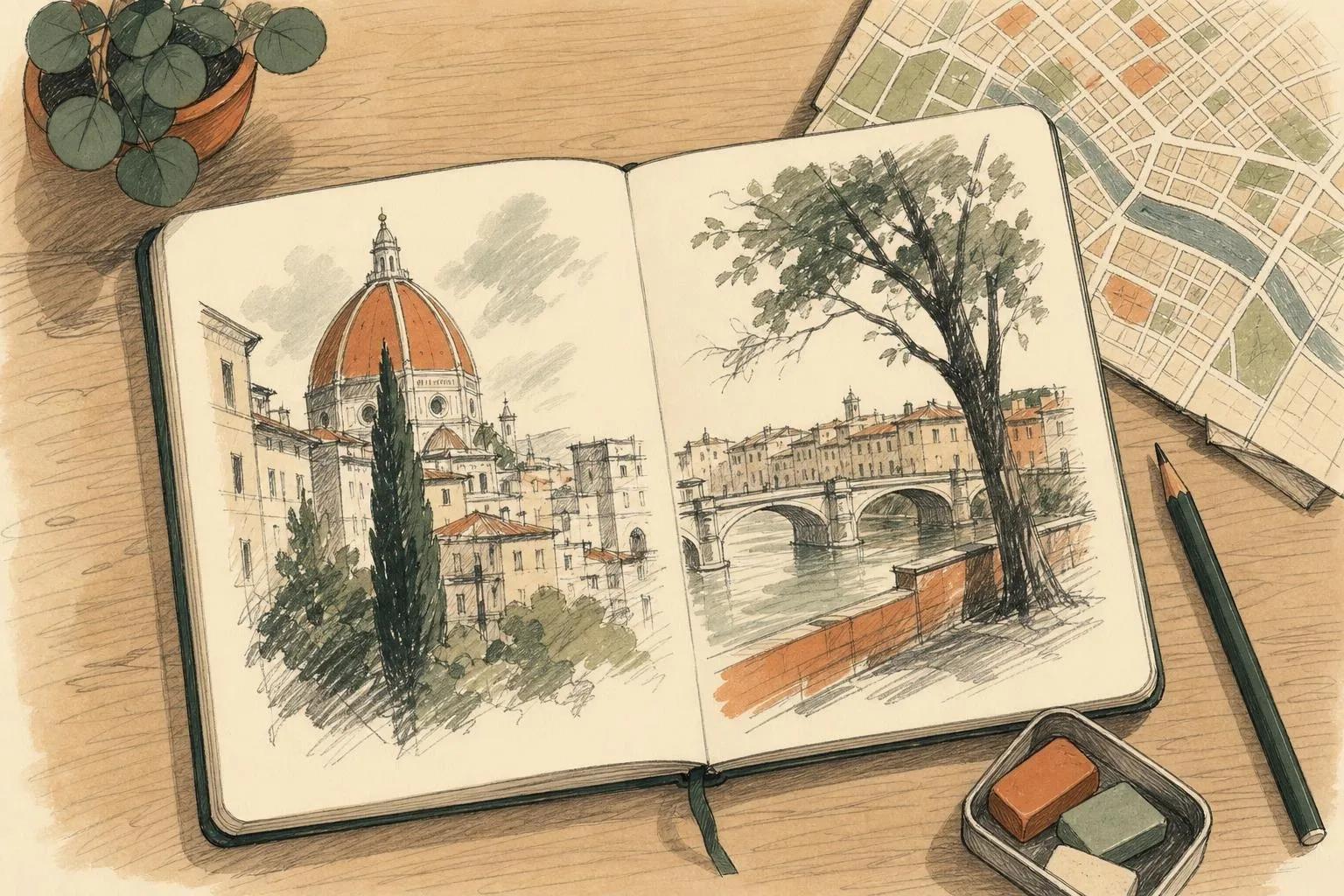
A drawer’s best tool is the one in the pocket when something interesting happens. A pocket sketchbook lowers the cost of starting to nearly nothing: no desk, no bag, no setup, just a few lines made in the minutes that would otherwise go on a phone. Articles on this site about drawing London and about free galleries both assume you have such a book to hand. This one explains how to choose it, fill it and keep going.
Choosing the book
Size is the first decision, and it matters more than paper. A pocket sketchbook should fit inside a coat or jacket pocket without bulging, which usually means a page of about A6 or smaller. Anything larger turns into luggage, and luggage is left behind. A hard cover is worth having, since it gives you something to rest on when standing at a bus stop or leaning against a wall.
Look for a stitched or sewn binding if you can, because a book that opens flat is easier to draw across both pages, and a glued spine tends to crack after a month in a pocket. Paper does not need to be fancy. A plain, lightly toothed sheet takes pencil, ballpoint and fineliner well. Very smooth paper smudges more, and very thin paper shows the drawing from the other side.
A cheap book has an advantage that is easy to overlook: you feel free to ruin a page. People who buy an expensive notebook often keep it blank for a year, afraid of spoiling it. If that sounds familiar, buy a second, cheaper one to use first.
Pocket sketchbook sizes in millimetres
UK paper sizes follow the ISO 216 A-series, in which each size has half the area of the one above it. A5 is 148 x 210 mm, A6 is 105 x 148 mm and A7 is 74 x 105 mm. Many books sold as pocket size do not follow the A-series at all. Moleskine’s pocket sketchbook is 9 x 14 cm, and Stillman & Birn makes pocket books of 89 x 140 mm. That format is narrower than A6, and the missing 15 mm of width is what lets it slide into the inside pocket of a jacket.
| Format | Page size | Where it goes | Good for |
|---|---|---|---|
| A5 | 148 x 210 mm | A bag or a large coat pocket | Seated gallery studies, longer drawings |
| A6 | 105 x 148 mm | A coat pocket | An all-round daily book |
| About 90 x 140 mm | An inside jacket pocket | Quick figures on the move | |
| A7 | 74 x 105 mm | A shirt or trouser pocket | Thumbnails and visual notes |
For a first sketchbook, A6 or the 90 x 140 mm pocket format is the safe choice. A standing figure can fill the page, and the book never needs a bag. A5 has twice the area of A6, so a two-page spread takes twice as long to fill. That is fine for someone who already draws at home, but it can stall a habit that is only a few weeks old.
Paper weight in gsm, and what it means
Paper weight is given in grams per square metre, written gsm or g/m². A higher number usually means a thicker, stiffer sheet. A plain writing notebook such as the Leuchtturm1917 Pocket uses 80 g/m² paper, which is fine for a pencil sketch but a dense fineliner drawing can show through from the back. The small sketchbooks in the table below run from 100 to 165 gsm. Paper for wet media is heavier again: Moleskine uses 165 g/m² in its sketchbook and 200 g/m² in its watercolour notebook.
| Book | Page size | Paper | Binding |
|---|---|---|---|
| Daler-Rowney Simply, hardback | Portrait, 54 sheets | 100 gsm, soft white, medium grain | Hardbound, perfect (glued) binding |
| Seawhite black cloth hardback, A6 | A6 portrait, 92 pages (46 sheets) | 140 gsm all-media cartridge | Sewn, cloth-covered boards |
| Stillman & Birn Alpha, softcover | 89 x 140 mm (3.5 x 5.5 in) | 150 gsm, white, medium grain | Soft cover |
| Moleskine Art Sketchbook, Pocket | 90 x 140 mm | 165 gsm, ivory, acid-free | Hard cover, opens flat to 180° |
| Leuchtturm1917 Notebook, Pocket (for comparison) | 90 x 150 mm | 80 g/m² writing paper | Thread-bound, opens flat |
The figures come from the makers’ product pages and UK stockists’ listings as published in November 2026. Ranges change, so check the current listing before buying. Stillman & Birn describes its Alpha paper as suited to dry media, ink and light washes.
Binding types
Four bindings turn up in small books. Sewn or thread-bound books open flat, so a drawing can run across the gutter, and both Leuchtturm1917 and Moleskine say theirs lie flat. Stapled cahiers, such as Seawhite’s 40-page Art Cahier, are thin and cheap enough to fill in a month and file away. Wirebound books with a double coil fold back on themselves, which helps when standing, but the coil snags on a pocket lining. Glued spines are the cheapest option and usually the first to crack.
The small kit that goes with it
The best kit is short. You will carry it every day, so every item has to earn a place. A workable set looks like this:
- one soft pencil, plus a spare, in a short length or a clutch type
- a black fineliner or ballpoint for when you want a bolder mark
- a small eraser, though many drawers learn to leave it out
- a clip or elastic band that holds the pages shut
That is all. The urge to carry watercolours, markers and a ruler for every occasion is a common way to make the habit heavy and then drop it. If you want colour, add a single water brush or one pale marker later, and only once you are drawing most days.
Keep the pencil attached to the book. A loop or a rubber band across the cover prevents the most common reason for not drawing, which is searching the bag for something to draw with. The same goes for the spare: a second pencil in a different pocket means a broken tip never stops a session.
Pencil grades
Graphite pencils are graded from hard H to soft B, with HB in the middle and F between HB and H. Staedtler’s Mars Lumograph range has 24 grades, from 12B at the soft end to 10H at the hard end. A pocket book needs only a narrow slice of that. HB suits light construction lines, 2B makes a good everyday drawing pencil, and a 4B or 6B gives quick darks. Grades of 2H and harder leave a pale line that is hard to see outdoors and can dent thin paper.
Soft leads are also thicker. Staedtler gives a lead diameter of about 2.0 mm for every grade from 2B to 10H, about 2.5 mm for 3B to 5B and about 3.6 mm for 6B to 11B. A thick soft lead blunts quickly and leaves graphite on the facing page, so a 6B is better kept short and capped.
Pens and ink
A ballpoint is the most forgiving pen to carry, since it has no nib to dry out and makes a line that can be pressed lightly or hard. A pigment-ink fineliner gives a steadier black. Sakura states that the ink in its Pigma Micron pens will not bleed or run if liquid touches the page after the ink has dried. That matters as soon as you add a water brush, because a wash over a waterproof line leaves the drawing intact. Test any pen on the back page of a new book before relying on it, as some papers take ink better than others. For drawing events and longer days out, the kit in the reportage drawing guide adds a brush pen, a clipboard and a folding stool.
Building the habit
The kit is the easy part; the habit is where most books are lost. Drawing has to compete with the phone, and it usually loses unless it has a fixed place in the day. The reliable method is to tie it to something that already happens: the first coffee, the train, the lunch break, or the minute you wait for a kettle.
Start with a target so small that failing it seems silly. One drawing a day, lasting no more than five minutes, is plenty. A full page is optional. A single object or a few quick lines of a person counts. Date every page, since a dated sequence is satisfying to flip through and shows how your hand changes over weeks.
What to draw
Beginners often stall because they cannot decide on a subject. The answer is to draw what is nearest and cheapest to find: a cup, a shoe, your own hand, the person opposite you on the bus. Everyday objects stay still, and people on public transport rarely notice a drawer who works quickly. Variety helps over time, but at the start any subject is better than waiting for a good one.
A few sketchbook ideas for beginners that suit a small page: draw each meal before eating it, draw the same window at the same hour for a week, or fill a page with the chairs in one cafe. On the Tube, shoes and bags hold still far longer than faces. A page of nothing but hands, your own included, teaches more about proportion than a whole figure drawn badly.
Practise short timed studies. Give yourself one minute for a gesture, three for a simple object and ten for something more complex. Time limits remove the chance to fuss and force you to decide what matters. If you want to practise the human figure with a model, the guide to life drawing sessions in London explains what a class looks like, and the pocket book is a natural place to keep your notes from it.
Using the book in public
Drawing in public is less awkward than it feels. Most people are absorbed in their own business, and a person with a small notebook looks like someone writing. Choose a spot with a back to a wall, so nobody stands behind you, and keep the book low and close. If someone asks what you are doing, a brief friendly answer is enough.
Museums and galleries are good places for a first public session because sketching is common there. The Turbine Hall at Tate Modern is a good example: free to enter, sheltered and never empty. Rules differ by venue, and the usual allowance is pencil in a small pad, which suits a pocket sketchbook exactly. Check the visitor page before you go. The kit described above sits comfortably within most policies.
Dealing with pages you dislike
Every sketchbook has weak pages, and most of them are the most useful ones. A bad drawing shows what you tried and where it broke. Resist the urge to tear pages out or to redraw them neatly. Instead, write the date, the place and a few words if you like, then turn the page.
If a drawing frustrates you, ask what went wrong in a single sentence: proportions off, line too timid, ran out of time. That sentence becomes the aim of the next sketch. Over a few months, patterns appear in what you note, and they point to what to practise.
When the pocket sketchbook is full
A finished book is worth keeping, even if it looks scruffy. Write the start and end dates on the cover and shelve it. Many drawers return to old books for ideas and are surprised by how much they have changed. Then buy the next one and start again, perhaps a little smaller or a little looser than before.
Leave the next blank book near the door tonight with a pencil beside it, and draw the first thing you see tomorrow.
FAQ
Questions, answered
01What size is a pocket sketchbook?
Most people settle on A6, which is 105 x 148 mm and close to postcard size, or on the narrower pocket format of about 90 x 140 mm that several makers use. A7, at 74 x 105 mm, fits a shirt pocket. The limit is what you will actually carry every day. A book that needs a bag gets left at home, while one that slips into a coat pocket comes along without a decision.
02What pencil should I carry?
A mid-soft pencil in the B or 2B range gives a clear line without smudging heavily, and a mechanical or a short wooden pencil with a cap travels well. Carry a spare, since a broken tip ends a sketch in a crowd faster than anything else. A small sharpener or a knife-free option avoids trouble on public transport.
03How often should I draw in it?
Daily is ideal, but a habit that survives is better than one that is ambitious. Five minutes a day, or one longer session at the weekend, produces a full book within a few months. Pick a trigger such as a commute, a coffee break or a lunch bench, and attach the drawing to it.
04What do I do with bad pages?
Leave them in. A sketchbook is a working record, and the pages you dislike show where you were last month. Tearing them out breaks the habit of drawing without judgement. If a page truly bothers you, turn it over, date the next one, and carry on.
05Do I need an expensive book?
No. Paper that takes pencil and light pen is enough, and a cheaper book encourages quick, messy drawing. Save the better paper for later, when you know what you like. Paper quality matters mostly for wet media, which rarely suits a pocket kit anyway.
06What gsm paper is best for a sketchbook?
For pencil and pen, anything from about 100 to 165 gsm works. Small sketchbooks from the main makers sit in that band: Daler-Rowney's Simply sketchbooks use 100 gsm, Seawhite's A6 hardback 140 gsm, Stillman & Birn's Alpha 150 gsm and Moleskine's sketchbook 165 gsm. Heavier paper shows less of the drawing on the other side. Watercolour needs a heavier sheet, which is why Moleskine's watercolour notebook moves up to 200 gsm.