Museum visitor guide
Tate Modern: A Free Entry Visitor Guide to London's Modern Art Museum
Tate Modern turned a closed riverside power station into one of the most visited modern art museums in the world. Here is how the building came about, what is free, what is not, and how to use it with a sketchbook.
Opening hours, prices and gallery rules checked on
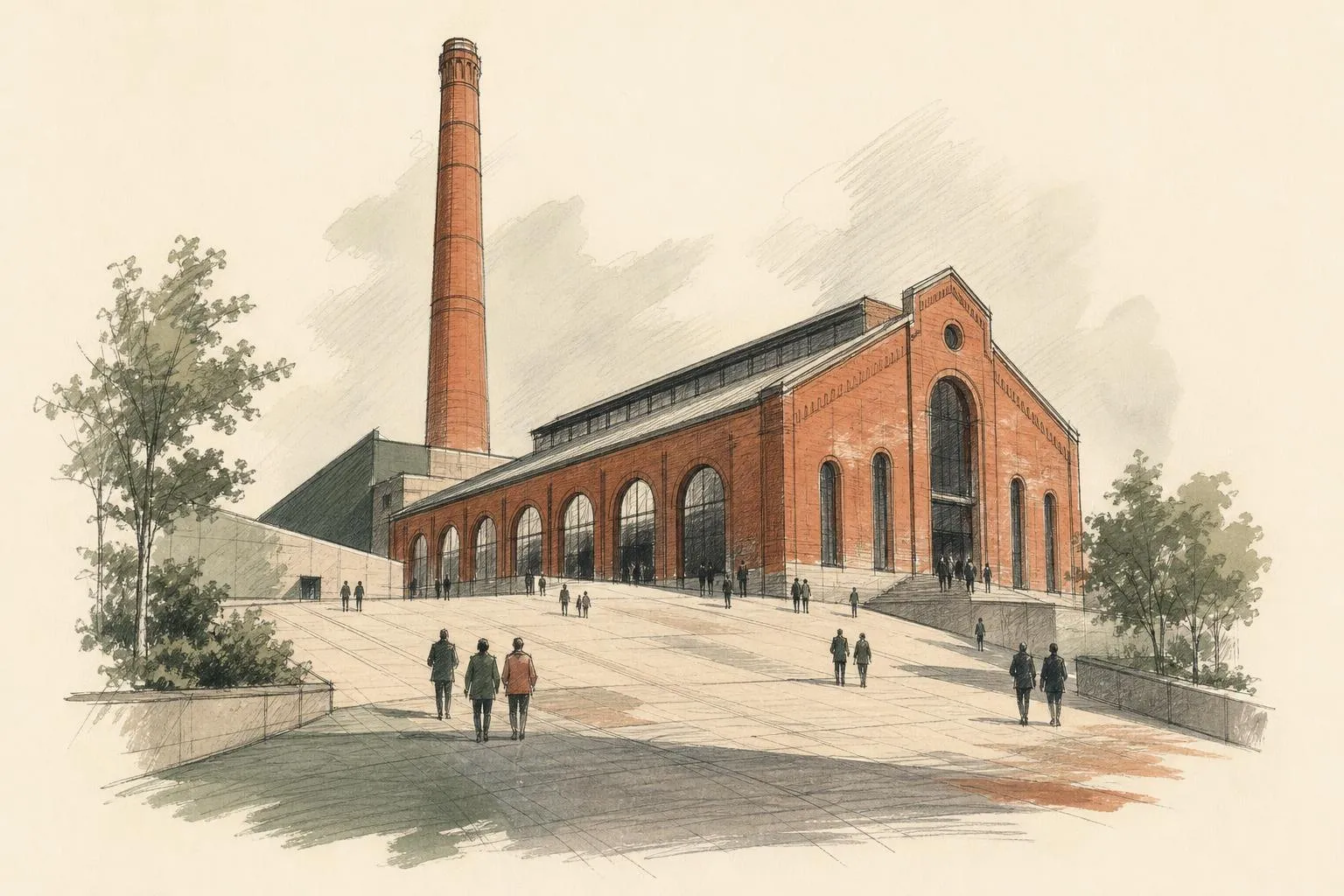
- Opened as a museum
- 11 May 2000
- Former use
- Bankside Power Station
- Visitors since 2000
- 115 million
- Late opening
- Fri and Sat to 21:00
Few buildings in London announce themselves like Tate Modern at Bankside: a huge brick block with a single square chimney, facing St Paul’s Cathedral across the river. Since it opened in May 2000, Tate counts 115 million visits, which makes this former power station one of the most visited modern art museums in the world, and the collection inside is still free for everyone. This visitor guide covers what most guides skip: the exact opening times and late evenings, the nearest stations with real walking distances, which rooms hold the famous works, where to eat and leave a bag, what an exhibition ticket costs, and what you may draw with. It also tells the story of how a modern art museum London had long lacked ended up inside a power station.
The modern art museum London built
The museum occupies what was Bankside Power Station, an oil-fired plant designed by the architect Sir Giles Gilbert Scott, whose name is also attached to the red telephone box and to Battersea Power Station across the river. Bankside was built in two phases between the late 1940s and the early 1960s, and sources differ on the exact dates of each stage. The station burned oil to feed the capital’s grid and was shut in 1981, when rising fuel costs made it uneconomic.


For years the empty building stood as a landmark with no job. In April 1994 the Tate Gallery announced that the site would become its new home for international modern and contemporary art, leaving the older Millbank building to concentrate on British art. The Swiss architects Herzog and de Meuron won the commission and chose to keep the bulk and character of the power station instead of replacing it. They kept the chimney, the brick walls and the long central hall, and added a light-filled glass structure on the roof. Tate Modern opened to the public on 11 May 2000. This visitor guide follows the building from that empty shell to the modern art museum London knows today.
What the conversion kept
The architects left a great deal of the working industrial building in place, including the steel, the concrete floors and the sheer volume. That decision matters to anyone who draws, because the structure itself is a subject: the repeating bays, the heavy brick surfaces and the long sightlines make easy study for perspective.
The Turbine Hall
The Turbine Hall is the heart of the old power station, the space that once held the generators. It runs 155 metres, the whole length of the building, and gives the museum its famous first impression, a slope leading down into a room so tall that people shrink to pencil marks. From the opening year it has hosted large commissioned works made specifically for it, beginning with Louise Bourgeois and continuing through artists such as Anish Kapoor and Olafur Eliasson. Many visitors remember the Eliasson sun installation of 2003 above all, when people lay on the floor looking up into a reflected glow. The Hyundai Commission for 2026-27, the eleventh in that series, is by the sound artist Tarek Atoui and runs until 11 April 2027, free to visit like every Turbine Hall work.


For a visitor with a pad, the Turbine Hall offers a rare kind of subject: a crowd at human scale inside a space too big to take in. Spend ten minutes at the edge and draw the standing and sitting figures, simplifying each into a few strokes. The hall is free to enter, and crowds change by the minute, so every sketch is a different composition.
The Blavatnik Building and the extension
By the 2010s the museum had outgrown its original plan, with visitor numbers far above what it was designed for. An extension on the south side, built over the former oil tanks and the old electrical substation, opened in June 2016. It was first known as the Switch House and was renamed the Blavatnik Building in 2017 after a major donor, and Tate says it added 60 per cent more display space. The building has ten floors; visitors use Levels 0 to 4 and Level 10, which is reached only by lift.
Level 10 is the high point of a visit for anyone who draws the city: a bar with drinks and snacks above the rooftops, river bends and the dome of St Paul’s. Its hours are shorter than the galleries’: 10:00 to 17:00 from Sunday to Thursday, with last orders at 16:30, and until 21:00 on Fridays and Saturdays. The open-air terrace has been closed at times, so treat the view through the glass as the plan and anything outside as a bonus.
Free entry: the collection displays
Free entry covers the core of the museum, the collection, arranged in thematic displays across the two main buildings rather than in a strict timeline. No time slot is needed, so visitors can come in at any point during opening hours. The display changes from time to time as works are rehung, so the specific rooms you see may differ from a friend’s visit last year.
What you can expect, broadly, is twentieth-century and contemporary painting, sculpture, photography and installation, with works by artists from many countries. Rooms vary in scale from intimate to cavernous. A sensible way to see them is to pick a floor, walk it once without stopping, and return to the two or three rooms that held your attention; trying to be thorough defeats the visit.
Two works most people come looking for have fixed addresses at the time of writing. Mark Rothko’s Red on Maroon (1959), one of the paintings made for the Seagram murals, hangs in Room 10 of the In the Studio display on Level 2 of the Natalie Bell Building. Marcel Duchamp’s Fountain, the urinal signed “R. Mutt” (the 1964 replica of the 1917 original), is in Room 7 of Materials and Objects on Level 4. Free guided tours of the collection run most days. If a favourite work matters to you, check Tate’s highlights page before the trip, since rooms are rehung.
Paid exhibitions
Alongside the free displays, Tate Modern runs special exhibitions that need a ticket. In late 2026 the adult price for the shows on was between £15 and £25, and the biggest ones sell out at weekends, so booking ahead pays. The discounts are worth knowing:
| Who | What Tate offers |
|---|---|
| Children under 12 | Free with a family ticket |
| Ages 12 to 18 | £5 per exhibition on a family ticket, up to four children per adult |
| Ages 16 to 25 | £5 tickets through Tate Collective, free to join |
| Students, disabled visitors, UK teachers | Concession price; a companion goes free if needed |
| Tate Members | Every exhibition free, lockers free |
Whether an exhibition is worth the price depends on your interest, and the free displays are a full visit in themselves. For comparison with other London options, see the guide to free museums in London.
Visitor guide: the nearest tube
Tate Modern is at Bankside, London SE1 9TG, on the south bank of the Thames. Tate publishes its own walking distances, and they are more useful than the usual “about ten minutes”:
| Station | Line | Distance on foot |
|---|---|---|
| Blackfriars | Thameslink rail; District and Circle | About 300 m from the South exit on the river |
| Southwark | Jubilee | About 600 m |
| Cannon Street | Rail; District and Circle | About 1,000 m |
| St Paul's | Central | About 1,100 m, over the Millennium Bridge |
| London Bridge | Rail; Northern and Jubilee | About 1,100 m along the river |
| Waterloo | Rail and four Tube lines | About 1,280 m |
The prettiest approach is from St Paul’s across the Millennium Bridge, which delivers you straight to the north entrance. Buses 40, 63 and 100 stop on Blackfriars Bridge Road, the 381 on Southwark Street and the 344 on Southwark Bridge Road. There is no car park; Blue Badge holders can book one of twelve spaces through Park Street at least 24 hours ahead, and cycle stands sit on Holland Street, 160 metres away.
The Tate to Tate boat
A river boat links the two Tates: it leaves Millbank Pier by Tate Britain and lands at Bankside Pier outside Tate Modern, running every 20 to 30 minutes during gallery hours. The adult fare is £14.40, children aged 5 to 15 pay £7.20 and Members £10.80. It turns a two-gallery day into one trip with a view, although Millbank Pier is not step-free at the moment.
Tate Modern opening times and lates
| Day | Opening times | Level 10 bar |
|---|---|---|
| Sunday to Thursday | 10:00-18:00 | 10:00-17:00 |
| Friday and Saturday | 10:00-21:00 | 10:00-21:00 |
Last entry is 30 minutes before closing, and the museum is shut only from 24 to 26 December. Tate’s own advice is that it is quietest at the start and end of the day, which suits drawing: arrive at ten, or come for the Friday and Saturday lates, when the galleries thin out after six.
Bags, food and facilities
The old cloakroom in the Natalie Bell Building has closed. Lockers on Level 0 of the Blavatnik Building cost £4, £6 or £8 by size, card only, and bags larger than 55 x 40 x 20 cm are not allowed in at all, so leave a big rucksack or suitcase behind.
| Where | Level |
|---|---|
| Restaurant | Natalie Bell Building, Level 6 |
| Espresso Bar | Natalie Bell Building, Level 3 |
| Terrace Café | Blavatnik Building, Level 1 |
| Level 10 bar, drinks and snacks | Blavatnik Building, Level 10 |
| Shops | Turbine Hall (Level 0), Riverside and Terrace shops (Level 1) |
Food and drink stay out of the galleries themselves, so a flask is for the riverside benches.
Tate Modern with kids, and access
For families the numbers are friendly: free entry to the collection, and children under 12 also go free to exhibitions with a family ticket. The Turbine Hall is the natural first stop, with space to move and a commission big enough to hold a child’s attention, and the free Tate Draw desks give children something to do with their hands.
Access is thought through. Every entrance is step-free, wheelchairs can be reserved free of charge, there are accessible toilets on every floor and a Changing Places toilet on Level 0 of the Natalie Bell Building, and quiet rooms on Levels 2 and 4 of the same building. Touch tours run on Wednesdays from 10:30 and on the last Saturday of the month, and relaxed hours for exhibitions run from 10:00 to 11:00 on the third Tuesday of each month.
Drawing in the galleries
Tate’s gallery rules are short and clear: “The use of charcoal, pastels, permanent markers and watercolour or oil paint is not allowed in the galleries.” Pencil, graphite and coloured pencil in a pad are the safe kit. Photography is allowed unless a sign says otherwise, but flash, camera supports and selfie sticks are not, which is a useful reminder that a quick sketch is often the better way to remember a room anyway.
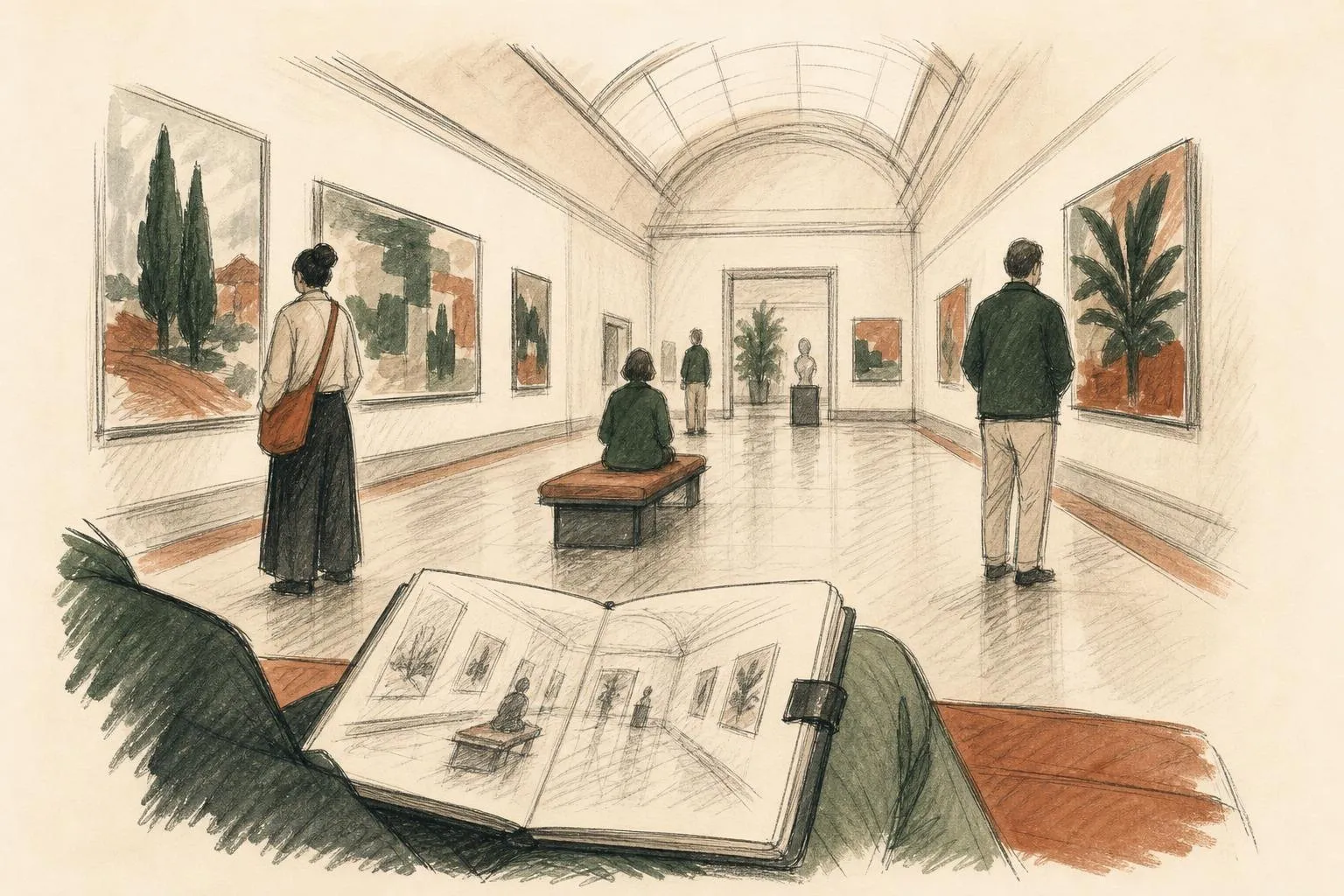
Tate Draw, the museum’s free drawing desks, sit in the Starr Foyer on Level 1 of the Natalie Bell Building and on Level 3 of the Blavatnik Building. A practical approach to the galleries is to pick one work and draw its basic shapes in five minutes, then draw the people looking at it. For a note on what to carry, the pocket sketchbook guide covers a minimal kit, and the advice on drawing a busy city applies equally well to the Turbine Hall’s crowds.
Plan for a two-hour visit
Start in the Turbine Hall and draw for ten minutes. Walk through one level of the collection displays and choose a room. Sit, draw a work for twenty minutes, then draw two or three visitors. Finish on Level 10 before it closes, at 17:00 on most days, with a ten-minute skyline. Leave before fatigue sets in; the river walk back toward Blackfriars or Borough Market is a fair reward.
Take a pencil, a spare, and a pad no bigger than a paperback, and decide on your first subject before you reach the door.
FAQ
Questions, answered
01Is Tate Modern free?
Yes, for the collection: Tate's own wording is that entry to the collection is free for everyone, with no time slot. Special exhibitions are ticketed, at £15 to £25 for an adult for the shows running in late 2026. Children under 12 visiting with a family go free, 16 to 25 year olds can get £5 tickets through the free Tate Collective scheme, and Members see every exhibition free.
02What was Tate Modern before it was a museum?
It was Bankside Power Station, an oil-fired electricity generating station designed by Sir Giles Gilbert Scott and built in two phases in the mid twentieth century. It stopped generating in 1981. Tate announced the site as the home for a new modern art museum in 1994, and the conversion was carried out by the architects Herzog and de Meuron.
03What is the Turbine Hall?
The Turbine Hall is the enormous entrance space running through the old power station, once home to the generators. It now hosts large commissions made for the room, beginning in the year the museum opened. It is free to enter and often the first place visitors stop to draw people crossing its sloping floor.
04Can you draw in Tate Modern?
Yes, with dry materials. Tate's gallery rules say charcoal, pastels, permanent markers, watercolour and oil paint are not allowed in the galleries, so a pencil and a pad are the safe choice. Photography is also allowed unless a sign says otherwise, but without flash, tripods or selfie sticks. There are free Tate Draw desks in the Starr Foyer on Level 1 of the Natalie Bell Building and on Level 3 of the Blavatnik Building.
05What time does Tate Modern close?
At 18:00 from Sunday to Thursday and at 21:00 on Fridays and Saturdays, with last entry 30 minutes before closing. It opens at 10:00 every day and is closed only from 24 to 26 December.
06What is the nearest tube to Tate Modern?
Blackfriars is closest by Tate's own measurements, about 300 metres from the station's South exit on the river. Southwark on the Jubilee line is about 600 metres away and St Paul's on the Central line about 1,100 metres, across the Millennium Bridge.
07How long should a visit take?
Allow at least two hours for the free displays if you want to see them properly and sit to draw, and a half day if you also have an exhibition ticket. The building is large, and trying to cover every level in one visit tends to leave people tired with little to show for it.