Memoir chapter
The Coronation 1953, China and the Panorama Commission Topolski Drew
Two very different assignments sit in this chapter: a wartime sketchbook from China and the pageantry of 2 June 1953. Both show how Feliks Topolski worked when the subject was too big to see all at once.
Published
Coronation Day figures, the frieze at Buckingham Palace and its 2013 display checked on
- Coronation
- 2 June 1953, Westminster Abbey
- China sketchbook
- Published in LIFE, March 1945
- Coronation mural
- Commissioned 1958, painted 1959-60
- Structure
- 14 friezes in two narratives
China in 1945: a country at war with itself
China had been fighting Japan since 1937, and by 1945 much of its population had been displaced. The Nationalist government under Chiang Kai-shek ruled from the inland city of Chongqing, supplies reached it by air and by the Burma Road, and the Communist forces in the north held territory of their own. Millions of civilians had walked away from the coast and the rivers as the front moved. A visitor in the last year of the war met refugees, conscript soldiers and porters on the same roads.
Topolski reached China as part of his war-artist tour, and the pictures he made there were reproduced in LIFE magazine in March 1945. The published sketchbook is made up of people on the move: refugees on the road, soldiers, and a ragged labourer carrying a load. He did not draw battles. He drew the people the war had pushed onto the roads, which is the same instinct visible in the earlier chapter on wartime India, Burma and China.
Later sources also credit him with a second visit in 1966, when Mao’s Cultural Revolution began and Red Guards filled the streets of the cities. The record of that trip is much thinner than the wartime one, so it is best treated as a pointer for further reading than as a settled account.
Key dates: China and the Coronation
| Date | What happened |
|---|---|
| 19 Mar 1945 | LIFE publishes Topolski's wartime China sketchbook |
| 1 Oct 1949 | The People's Republic of China is proclaimed |
| 6 Feb 1952 | Elizabeth II accedes to the throne |
| 29 May 1953 | Everest is climbed; the news reaches London on Coronation morning |
| 2 Jun 1953 | Coronation at Westminster Abbey: about 27 million watch on television in the UK and 11 million listen on radio |
| 1958 | Prince Philip commissions the Coronation mural |
| 1959‑60 | The mural is painted, now at Buckingham Palace |
| 16 May 1966 | The Cultural Revolution is launched in China |
| Summer 2013 | The frieze is shown on the visitor route of the Buckingham Palace summer opening, in the exhibition The Queen's Coronation 1953 |
The Coronation 1953, built for the cameras
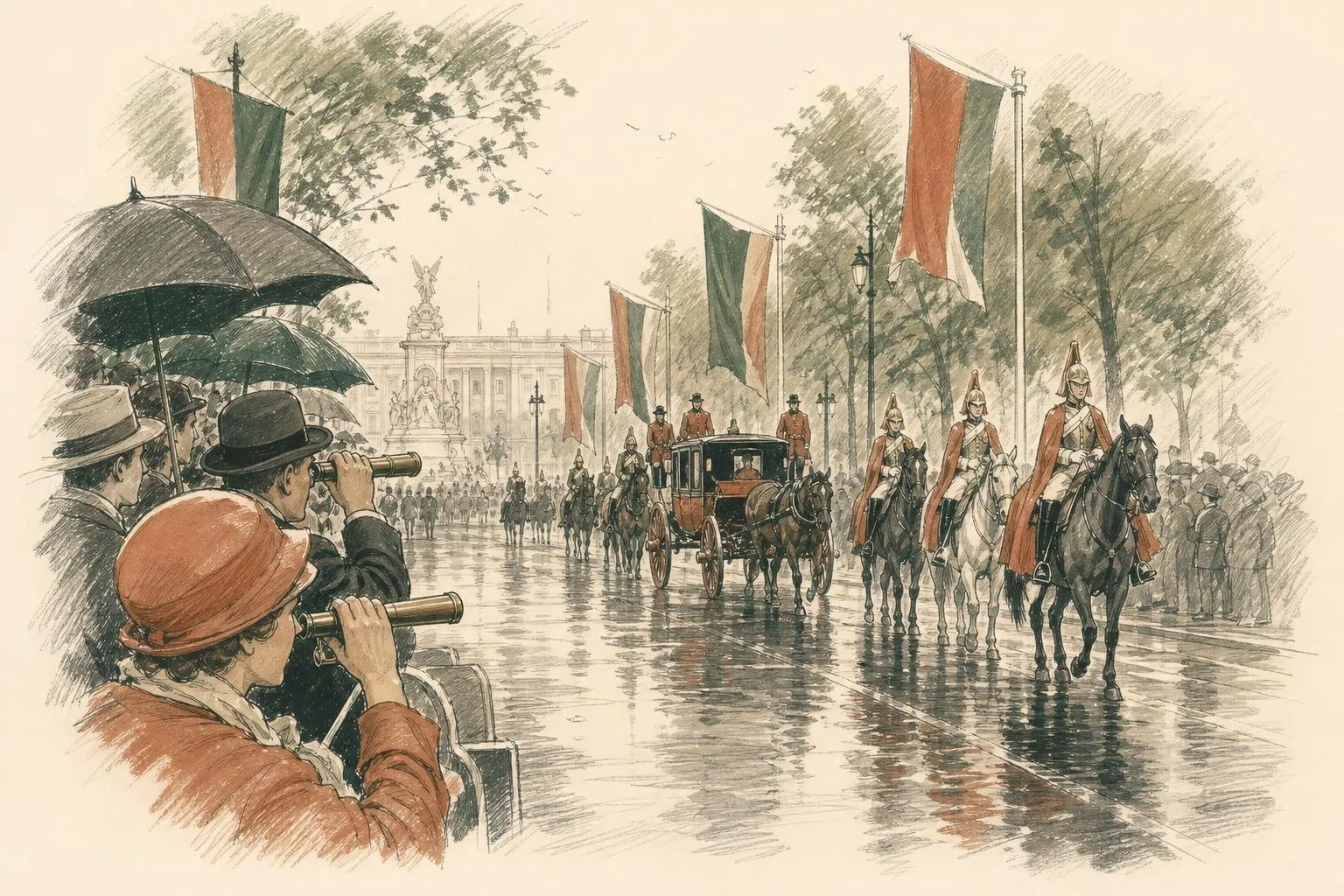
Elizabeth II was crowned at Westminster Abbey on 2 June 1953. The service was conducted by the Archbishop of Canterbury, Geoffrey Fisher, and for the first time much of it was televised. Households bought or borrowed sets to watch, and the broadcast is often cited as the moment television became a national habit in Britain. The weather was cold and wet. News that a British expedition had reached the summit of Everest had arrived that morning, and the procession route through London was lined with crowds who had waited overnight under umbrellas and tarpaulins.


Coronation Day 1953 in numbers
According to the official royal website, 8,251 guests filled Westminster Abbey, and the service began at 11.15am and lasted almost three hours. Just under 30,000 servicemen took part in the wider procession, from the Royal Navy, the Army, the RAF and the Commonwealth, and 7,000 police were brought in from 75 provincial forces to help the Metropolitan Police. The return procession alone covered 7.2 km and took its 16,000 participants about two hours.
The press turned out in similar numbers: more than 2,000 journalists and 500 photographers from 92 nations covered the route. Of the 36 million people living in the UK, an estimated 27 million watched Queen Elizabeth II’s coronation on television. Many Londoners had camped on The Mall the night before to keep their places.
Queen Salote of Tonga rode in an open carriage through the rain and became one of the favourites of the day. Foreign heads of state, Commonwealth prime ministers and peers in their robes crowded the Abbey. For an artist, the problem was obvious: the interior was fixed in place, the procession ran for miles, and no single seat saw both. Topolski was not the only one working on it. Terence Cuneo was commissioned by the Lord Lieutenants to paint the ceremony, Herbert James Gunn painted the State Portrait of the Queen in her Coronation robes in 1954, and Cecil Beaton took the best-remembered official photographs.
Recording the Coronation 1953 on the spot
Topolski was one of the artists commissioned by the Ministry of Works to record the Coronation, and sketches he made of the occasion are now held in the Government Art Collection. Several titles in that collection name individual figures, such as the foreign guests arriving at the Abbey, the state procession’s foot guards and royal grooms, and Churchill with the peers after the ceremony. They are quick, selective drawings: the portrait of a role, not a full set piece.
That year also marked the start of his own publication. From 1953 he issued his Chronicle, a broadsheet printed from his drawings and published from his studio under the railway arches. The Coronation 1953 was an obvious first subject for a draughtsman who wanted to show events as they looked to someone standing in them.
The panorama: 14 friezes and a long wall
The large painting came later. Prince Philip, Duke of Edinburgh, commissioned Topolski to produce a mural of the Coronation, reported in 1958 and painted in 1959 and 1960. It hangs in the Lower Corridor at Buckingham Palace and runs to about 29 metres. The work is arranged as 14 friezes in two narratives, one titled In the Streets, which follows the processions to Westminster Abbey, and one titled In the Abbey, which shows the procession out after the service. A Royal Collection publication describes it as the Coronation Frieze.
The panorama is the right form for the subject. A frieze unrolls like a procession, so the eye travels at walking pace past coaches, bands and uniformed units, exactly as a spectator on the pavement does. The same format later carried the huge Memoir of the Century, begun in 1975 and several hundred feet long.
The Coronation Frieze at Buckingham Palace
The official royal website calls Topolski the official artist of the Coronation and describes his permanent record as painted in 14 sections, each more than a metre high. The panels are oil on panel. One of them, The Coronation III, dated 1959-60 and catalogued by the Royal Collection Trust as RCIN 405235, was included in the Trust’s exhibition Prince Philip: A Celebration at Windsor Castle. The Duke of Edinburgh, who commissioned the frieze, was the subject of that show.
Because the frieze sits in a working corridor of the palace, the public sees it only when it is placed on a visitor route. That happened in 2013, the sixtieth anniversary, when the Royal Collection Trust staged The Queen’s Coronation 1953 for the summer opening of the State Rooms and listed the Coronation Frieze, dated there to 1960, among the works shown along the route. The same display hung Gunn’s State Portrait and dressed the State Dining Room table to evoke the Coronation banquets of 3 and 4 June 1953. Summer exhibitions change every year, so anyone hoping to see the Topolski Coronation painting at Buckingham Palace should check the Royal Collection Trust’s listings before booking.
The 1953 sketches are elsewhere. They belong to the Government Art Collection, which lends works to British government buildings, and they are catalogued under titles such as Peers in Coronation Robes, a pen and ink and watercolour sheet dated 1953. Set beside the finished frieze, they show how a page of quick notes from Coronation Day 1953 grew into a painting six years later.
Why these two assignments sit together
The official record of the Coronation 1953 is a set of photographs, a film and a printed order of service. What a drawing adds is selection. Topolski’s lines leave out most of the scene, and what remains is what a person standing there would have remembered: the wet pavement, the tilt of a crown, a soldier’s glance sideways at the crowd. In the Chinese sketchbook the same principle works at a different scale, with a single walker standing in for a whole displaced region.
A wartime sketchbook from China and a coronation commission have little in common as events, but the method is shared. Both come from an artist who accepted that he could not see everything, and who chose to draw the parts that told you the rest: a refugee’s bundle, the line of a bearskin, a face turned towards a passing coach. The drawing is built from fragments set side by side.
For readers who want to try the discipline, the guide to reportage drawing describes a simple routine, and the biography page gives the wider career. The previous chapter covers post-independence India and the next moves to America in the 1960s. The whole sequence is indexed on the memoir overview.
FAQ
Questions, answered
01Did Topolski draw the Coronation on the day itself?
He was among the artists commissioned by the Ministry of Works to record the Coronation in 1953, and sketches from that work are now in the Government Art Collection. The large panorama came later, as a separate commission, and was built from observation, memory and the studio drawings rather than from one day of sketching.
02Who commissioned the Coronation panorama?
Prince Philip, Duke of Edinburgh, commissioned Topolski to paint a large mural of the Coronation of Queen Elizabeth II. Published sources date the commission to the late 1950s, with 1958 and 1959 both given. The work is arranged as 14 friezes in two narratives, one about the streets and one about the Abbey.
03What did Topolski draw in China?
His China sketchbook from the Second World War, published by LIFE magazine in March 1945, shows refugees on the road and soldiers, among other figures. Later sources also credit him with returning to China in 1966, at the start of the Cultural Revolution, though details of that trip are thinner.
04Can you see Topolski's Coronation painting at Buckingham Palace?
The frieze hangs in the Lower Corridor at Buckingham Palace, a working royal residence, so it is not on permanent public view. In 2013 it was shown on the visitor route of the summer opening as part of the exhibition The Queen's Coronation 1953. Whether it is on the route in a given year depends on that summer's display, so check the Royal Collection Trust before booking.
05Why does the panorama format suit a procession?
A procession is long and continuous, so a single frame cuts it into pieces. A frieze lets the eye travel with the coaches and marching units, the way a spectator on the pavement turns their head. Reporting artists have used the form for processions for centuries.
06How can you try this kind of drawing yourself?
Pick a street with steady movement, such as a market or a station concourse, and draw the same stretch for twenty minutes without erasing. Overlap the figures and let some run off the edge. The reportage drawing guide on this site covers materials and a simple routine.