Free London art
Free Museums London: The Best Art Galleries Guide for Drawing and Looking
London keeps most of its great permanent collections open without a ticket. This guide sorts the free museums and art galleries by what they offer a person with a sketchbook, and flags where the charges begin.
Opening hours, lates and drawing rules checked on
- Cost of entry
- Free permanent collections
- Usually ticketed
- Special exhibitions
- Free late openings
- Friday at 5 venues, to 22:00 at the V&A
- Safe kit everywhere
- Graphite pencil, pad up to A3
London is unusual among world capitals in how much serious art it lets anyone walk in and look at for nothing. The national collections have long been open on a free general-admission basis, and the result is a city where an afternoon with a sketchbook can cost the price of a pencil. This page is a practical guide to the free museums London offers to people who care about pictures, sculpture and drawing, with notes on where the free part ends.
Most lists stop at “it’s free”. This one goes further, because the questions that decide a visit are smaller: what time the doors close, which evening the gallery stays open late, which station is nearest, and whether a pencil, a stick of charcoal or a folding stool will get you a polite word from a warder. The opening times, stations and drawing rules below are taken from each venue’s own visitor pages as published in November 2026. Temporary exhibitions are ticketed almost everywhere and are left out on purpose, and the museum’s own site stays the final word on the day.
The best free museums in London for art lovers
The strongest case for the free museums of London is concentration. Within a short ride of each other sit a thousand years of painting, the sculpture of several civilisations, and the best twentieth-century collection in the country. Here are the venues that matter most to someone who draws or simply likes to look.


National Gallery, Trafalgar Square
The National Gallery’s permanent collection is free, and it covers Western European painting from the thirteenth century to the early twentieth. The rooms are arranged roughly by date and school, which makes it easy to follow one thread, such as portraits or Dutch interiors, for an hour. Big touring exhibitions are ticketed, but the main floor is open to anyone. It is also a good place to learn composition by drawing small thumbnail diagrams of a painting’s big shapes rather than copying detail. The gallery’s sketching page is unusually generous on materials, but it asks you to spend no more than ten minutes in front of any one painting so others can see it, which suits exactly that kind of quick study.
- Open daily 10:00-18:00, Fridays to 21:00
- Nearest Charing Cross rail, about 200 m; step-free Tube at Tottenham Court Road and Westminster
- Drawing pencils, crayons, graphite, ball-point and medium or hard charcoal; pads up to A3
- Booking free tickets give fast-track entry, walk-up entry also works
National Portrait Gallery, St Martin’s Place
Next door in spirit and in walking distance, the National Portrait Gallery shows British portraiture from the Tudors to the present, and its permanent display is free. For a drawer the interest is double: the sitters, and the many ways artists have solved the problem of a face. Portrait rooms are generally calm, and the benches suit a ten-minute study of a pose. Folding stools are kept on each floor, which makes this one of the easiest free art galleries in London for a seated session.
- Open daily 10:30-18:00, Fridays and Saturdays to 21:00
- Address St Martin's Place, WC2H 0HE, beside the National Gallery
- Drawing graphite and coloured pencils only, pads no bigger than A3
- Access every entrance is step-free


Tate Modern, Bankside
The collection displays at Tate Modern are free, and the building is big enough that a visit is best planned around two or three floors. Paid exhibitions run alongside. A separate page covers the Tate Modern visitor guide in detail, including the building’s history and how to get there.
- Open Sunday to Thursday 10:00-18:00, Fridays and Saturdays to 21:00
- Nearest Southwark, about 600 m; Blackfriars, about 800 m
- Drawing dry media; charcoal, pastels, permanent markers and paint are not allowed at any Tate
- Access step-free via the Turbine Hall ramp or the Blavatnik Building
Tate Britain, Millbank
Tate Britain holds British art from 1500 to the present in a free collection, with a strong run of Romantic landscape and twentieth-century figure work. Of all the large galleries it is probably the most useful for understanding the tradition that British draughtsmen, including reportage artists, grew out of. There is no late opening, so it is a daytime gallery, and usually a calmer one than its sister on Bankside.
- Open daily 10:00-18:00
- Nearest Pimlico, about 600 m; Vauxhall, about 850 m
- Drawing the same Tate rule: no charcoal, pastel, markers or paint
- Access step-free through the Manton entrance on Atterbury Street while the Millbank entrance is closed


British Museum, Bloomsbury
The British Museum offers free general admission to its permanent collection. For drawing it is hard to beat: the Greek and Roman sculpture, Egyptian figures and Assyrian reliefs all stay perfectly still. Many life-drawing teachers send students here to study the figure in stone before they draw living models. The museum welcomes sketching but leaves the details of media, stools and easels to the Information Desk, so ask there on arrival. One exception is fixed: no sketching at the Bayeux Tapestry display.
- Open daily 10:00-17:00, Fridays to 20:30
- Booking free; for the Friday late a timed slot is the way to guarantee entry
- Address Great Russell Street, Bloomsbury, a short walk from Tottenham Court Road and Holborn
- Access lifts either side of the Great Russell Street steps
Victoria and Albert Museum, South Kensington
The V&A’s permanent collection is free; its fashion and design blockbusters are separately ticketed. The sculpture and cast courts are the draw for artists, since the full-size plaster casts of monuments give a patient subject in a spacious hall. The V&A is the one big museum whose rules actively encourage drawers: graphite, coloured pencils and white chalk are suggested, stools are allowed in most galleries, and only easels, charcoal, crayons and wet media are out. On Friday evenings it stays open until 22:00, the latest of any free museum on this list, though some galleries close at the usual time.
- Open daily 10:00-17:45, Fridays to 22:00
- Nearest South Kensington, 5 minutes on foot
- Drawing graphite, coloured pencils, white chalk; stools in most galleries; no easels
- Access step-free at the Cromwell Road and Exhibition Road entrances


Wallace Collection, Manchester Square
This national museum occupies a former townhouse and shows French eighteenth-century painting, furniture and arms and armour, with free admission. It is smaller and quieter than the giants, which suits slow work with a pencil. The Wallace also lends gallery stools from the landing, and its list of allowed media is the most precise in London: graphite, coloured pencils, graphite sticks, Conté and compressed charcoal are fine, while loose charcoal, chalk, felt-tips, pastel and anything with water are not. Sketching is limited to the permanent rooms, not temporary exhibitions.
- Open daily 10:00-17:00
- Nearest Bond Street, 7 minutes; Marble Arch, 10 minutes
- Booking none for individuals; groups of six or more book ahead
- Access step-free entrance and a lift to every floor


Sir John Soane’s Museum, Lincoln’s Inn Fields
Sir John Soane’s house in Holborn is free to enter and packed floor to ceiling with casts, paintings and architectural fragments. Every wall is a composition, but this is a place for looking, not drawing: the museum does not currently permit sketching. Go to study how Soane stacked light, mirrors and fragments in a tiny space, then take the memory to the bench in Lincoln’s Inn Fields outside and draw it there. It keeps short hours, so plan around them.
- Open Wednesday to Sunday 10:00-17:00, closed Monday and Tuesday
- Nearest Holborn, 5 minutes
- Booking free, no need to pre-book
- Drawing not currently permitted inside


A note on what is not free
The Courtauld Gallery at Somerset House has one of the finest Impressionist and Post-Impressionist collections in London, but general admission is ticketed, so it does not belong on a free list. The Dulwich Picture Gallery in south London, the oldest public picture gallery in England, also charges for its collection. It sits here only as a reminder to check before assuming. The same goes for most private galleries and many historic houses.
Why free museums in London suit drawers
Drawing is a habit that lives or dies on friction. A paid ticket creates pressure to see everything and get value for money, which is the opposite of what a drawing session needs. When entry is free, you can walk in for twenty minutes, draw one cast, and leave without feeling you wasted a fee. That is why many illustrators and reportage artists treat the free museums London has to offer as an extension of their studio, a place to practise looking between jobs.
The same freedom changes how you use the best art galleries. Instead of marching through every room, you can adopt a single painting for a month and return to it weekly. Copying and studying from the old masters has been a standard training method for centuries, and the national collections were built partly to support it. A page of small studies from one picture teaches more about structure, light and edges than any amount of photographs.
Choosing between art galleries
Pick by the kind of drawing you want to do, not by fame. If the aim is figure work, choose a venue with sculpture, which means the British Museum or the V&A. If the aim is composition and tone, the National Gallery’s paintings give you clear value structures to simplify. If the aim is to loosen your hand with unusual subjects, Tate Modern’s large installations and mixed-material works offer shapes you will not meet elsewhere. Visitors themselves are the constant subject: every gallery has people standing, leaning, pointing and checking phones, and the postures repeat in a way that makes them good practice.


A useful test is the bench. Before committing to a room, look for somewhere to sit with a clear view of something worth drawing and room behind you. A gallery with good benches will serve a sketcher better than one with better pictures and nowhere to stand without blocking a doorway.
Free museums open late on Fridays
For anyone who works office hours, the most useful fact about the free museums in London is that several stay open into the evening. The rooms empty out after six, the light changes, and an evening session after work costs nothing.
| Venue | Late opening | Closes |
|---|---|---|
| V&A South Kensington | Friday | 22:00 (some galleries earlier) |
| National Gallery | Friday | 21:00 |
| National Portrait Gallery | Friday and Saturday | 21:00 |
| Tate Modern | Friday and Saturday | 21:00 |
| British Museum | Friday | 20:30, timed slot advised |
Tate Britain, the Wallace Collection and Soane’s Museum keep daytime hours only.
What you can draw with: the rules compared
The single most common reason a sketcher gets stopped is the wrong material, and the rules really do differ. Charcoal is the clearest case: medium or hard charcoal is allowed at the National Gallery, compressed charcoal only at the Wallace Collection, and none at all at either Tate or the V&A.
| Venue | Allowed | Not allowed | Stools |
|---|---|---|---|
| National Gallery | Pencil, crayon, graphite, ball-point, medium or hard charcoal; up to A3 | Paint (except on the copyist scheme) | Ask staff |
| National Portrait Gallery | Graphite and coloured pencils; up to A3 | Everything else | On every floor |
| Tate Modern and Tate Britain | Dry media | Charcoal, pastel, permanent markers, watercolour, oil | Ask staff |
| V&A | Graphite, coloured pencils, white chalk | Charcoal, crayons, wet media, easels | In most galleries |
| Wallace Collection | Graphite, coloured pencils, Conté, compressed charcoal | Loose charcoal, chalk, felt-tips, pastels, water, easels | Lent from the landing |
| British Museum | Ask at the Information Desk | Sketching at the Bayeux Tapestry | Ask at the desk |
| Sir John Soane's Museum | Sketching not currently permitted | - | - |
The short version: a graphite pencil and a pad no bigger than A3 are accepted at every free gallery that allows drawing. Bring anything else only after checking the venue.
Etiquette that keeps you welcome
Drawing in public spaces works because most drawers behave sensibly. Stay out of other visitors’ sightlines, keep your bag off the floor of busy walkways, and step aside if a group arrives to look at your chosen picture. If a visitor asks what you are drawing, a short answer and a friendly turn back to the page usually ends the conversation without awkwardness. Never lean on a plinth, a frame or a display case, and keep a safe distance from every object, since alarms and staff attention are there for good reasons.
Photography has its own rules in each venue, and some rooms or loans are marked as no-photography areas. Treat those signs seriously, and check the same visitor page you read for drawing policy.
Drawing in the galleries: a guide
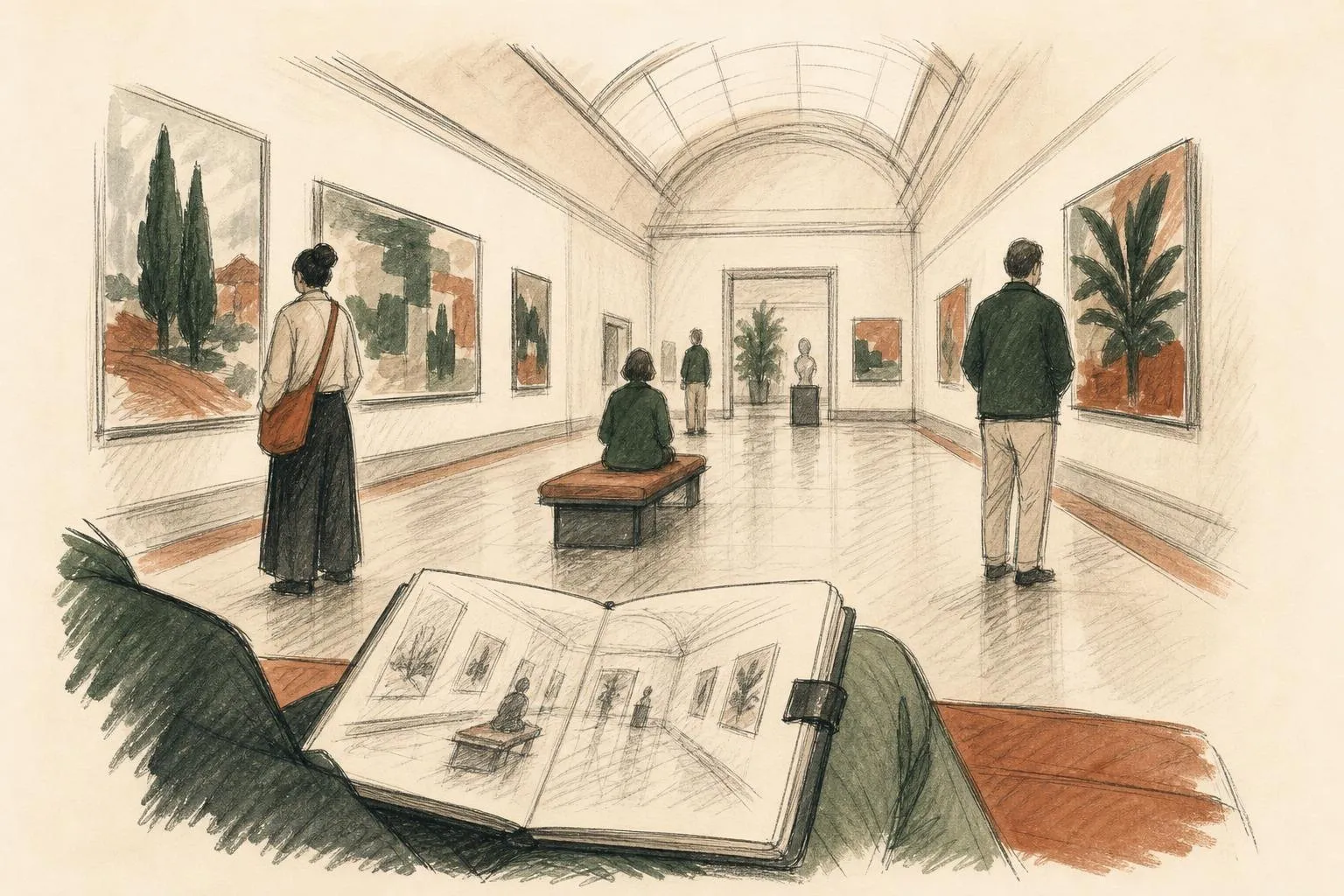
Sketching in museums is common and mostly tolerated, with limits that exist to protect works and other visitors. Pencils and small pads are the standard allowance in most London venues. Charcoal, pastel, ink and anything wet are often forbidden, because a drip or a smear on a floor or a frame costs more than anyone wants to explain. Easels are rarely allowed in busy rooms, and folding stools are accepted in some galleries and refused in others.
Because the rules sit in each venue’s visitor information and are updated from time to time, the safest routine is brief. Read the page before you go, ask a member of gallery staff if a room looks restrictive, and keep your kit small enough to disappear into a coat pocket. A pocket pad and two pencils meet nearly every policy, and the pocket sketchbook guide lists what to carry.
What to draw first
People new to drawing in public often freeze in front of famous pictures. A kinder start is to ignore the masterpieces and draw whatever is nearest: a bench, a plinth, a visitor leaning in to read a label. Visitors move slowly in galleries, which makes them better models than they look. If you want formal practice with the figure, the guide to life drawing classes in London explains how sessions with a model work, and gallery drawing is a good supplement between classes.
How long to stay
An hour is a sensible unit. Choose one room, do four or five sketches of ten minutes each, and leave while you still enjoy it. A single gallery visited three times produces more than three galleries visited once, since the second visit starts with familiarity.
Free museums London: a one-day route
Most of the free museums London has to offer sit on three short routes, so the easiest plan is geographic.
- Trafalgar Square and Bloomsbury. The National Gallery and the National Portrait Gallery share a pavement. From there the British Museum is roughly a 15-minute walk north, which makes this the classic day of free museums in central London. On a Friday, finish at the British Museum’s late opening.
- Bankside and the river. Tate Modern in the morning, then a walk along the South Bank, which is also good ground for drawing London’s moving street life. On Fridays and Saturdays the gallery stays open until 21:00.
- South Kensington. The V&A sits next to the Natural History Museum and the Science Museum, both also free. Draw at the V&A, rest in its garden courtyard, and stay for the Friday late.
Tate Britain and the Wallace Collection each justify a quiet half day of their own. Soane’s Museum fits between Holborn and Bloomsbury on any Wednesday to Sunday.
Free museums in London for kids
The South Kensington route doubles as the best plan for children. The Natural History Museum and the Science Museum are free to enter, and the Young V&A in Bethnal Green is a free museum built for children. Children who draw do best with the same simple kit as adults: a soft pencil and a small pad, and ten minutes in front of one dinosaur rather than an hour of rooms.
Unusual free museums in London
Beyond the national collections, a handful of smaller places reward a curious visitor. The Wellcome Collection by Euston, on medicine and the body, and UCL’s Grant Museum of Zoology, a dense room of skeletons in jars, are both free and full of shapes that sit still for a drawing. Their hours are shorter than the big museums, so check before going.
Build a rest into the plan. Gallery fatigue is physical, and drawing deepens it because you stand or sit still while concentrating. Museum cafes cost money, so a flask and a sandwich in a park beside the gallery keep a free day free.
Before leaving, put three things in the bag: a pencil with a spare, a pad no larger than a paperback, and a note of the closing time of the last room you plan to see. Then pick one object on arrival and start with it.
FAQ
Questions, answered
01Which museums are free in London?
The national museums and galleries are free for their permanent collections: the National Gallery, National Portrait Gallery, Tate Modern, Tate Britain, British Museum, V&A, Wallace Collection, Natural History Museum and Science Museum among them, along with smaller places such as Sir John Soane's Museum. Special exhibitions are usually ticketed.
02Which free museums in London are open late?
The V&A stays open until 22:00 on Fridays. The National Gallery is open until 21:00 on Fridays, the National Portrait Gallery and Tate Modern until 21:00 on Fridays and Saturdays, and the British Museum until 20:30 on Fridays, where a free timed slot is the way to guarantee entry.
03Are all museums in London free?
No. Many national museums and galleries do not charge for their permanent collections, but private and independent venues usually do, and nearly every free venue charges for its major temporary exhibitions. The Courtauld Gallery, for example, sells tickets for general entry. Check the venue's own site before travelling, because arrangements and booking rules change.
04Can you draw in London's free galleries?
Usually, with conditions. A graphite pencil and a pad up to A3 are accepted wherever drawing is allowed, while wet media and easels are refused almost everywhere and charcoal rules differ by venue. Some rooms, especially small historic houses, restrict bags and stools. Each venue publishes its own rules, and a member of gallery staff can confirm them on arrival.
05Do you need to book for free entry?
Most free collections take walk-in visitors. The National Gallery offers free tickets for faster entry, the British Museum advises a free timed slot for its Friday late, and exhibitions almost always need a ticket. Because policies move, look at the booking page of the venue on the day you plan to go.
06Which free gallery is best for a first visit?
The National Gallery suits a first visit if you want classic painting in a compact route, and Tate Modern suits twentieth-century and contemporary work in a very large building. For a quieter session with a pad, the Wallace Collection rewards slow looking and lends stools; Sir John Soane's Museum is worth a visit too, but it does not currently allow sketching.
07What is worth drawing in a museum?
Sculpture and plaster casts hold still, which makes them kind to beginners, and the visitors looking at paintings make a second subject. Many drawers alternate: one study of an object, then a few quick figures of people in the room. Short timed sketches build confidence faster than one long copy.