Memoir chapter
Hippies in London: The 1960s Counterculture as Drawn on the Spot
London's hippies were never a single crowd. They were a loose scatter of clubs, shops, magazines and open-air gatherings, which is why a reportage artist working with a pen was well placed to record them.
Published
The 1965 Albert Hall poetry reading (Royal Albert Hall catalogue) and where its records are held checked on
- Poetry reading
- Royal Albert Hall, 11 June 1965
- Alexandra Palace all-nighter
- 29 April 1967
- Hyde Park free concert
- 5 July 1969
- Chronicle subjects
- Hippies, punks, Black Panthers
London in the 1960s: the counterculture
By the middle of the decade London had a young, mobile population with money to spend and a pop industry of its own. Out of that came the 1960s counterculture, a network of people who rejected the dress, the work routines and in many cases the drug laws of their parents. Its early landmarks were small. The Indica bookshop and gallery opened in Mason’s Yard, near St James’s, in 1965. On 11 June 1965 the International Poetry Incarnation at the Royal Albert Hall drew some seven thousand people to hear American and British poets, among them Allen Ginsberg.


The scene found an organ and a venue the following year. International Times, the underground newspaper, was launched at the Roundhouse in October 1966, and the UFO club began its Friday nights on Tottenham Court Road that winter, with light shows and long sets by Pink Floyd and Soft Machine. The word hippie came from San Francisco, but in London the people tended to call themselves heads or freaks, and the press supplied the label.
The Albert Hall poetry reading, 1965
The Royal Albert Hall’s own performance catalogue gives the clearest account of the evening. The International Poetry Incarnation began at 8pm on Friday 11 June 1965 and ran for about four hours. It was put together at short notice, and the seventeen poets, mostly American and British, were given no running order. Ginsberg opened with a chant, Adrian Mitchell read his anti-Vietnam War poem To Whom It May Concern, and William S. Burroughs was heard on tape. Audience members were handed flowers as they came in.
Attendance figures differ. The catalogue settles on about 7,000, while The Times reported at least 7,000, the organiser John Hopkins remembered 6,000 and the poet Michael Horovitz put it above 7,500. The press was split as well. The Hall’s general manager attacked the content in the Daily Mail, and the Times Literary Supplement said the evening had made literary history. Hopkins later called it the moment the British counterculture first came together, and the Hall’s catalogue counts it among the high points of the swinging sixties. For anyone tracing hippies in London in the 1960s, it is the obvious place to begin.
Topolski’s Chronicle gave the reading a broadsheet of its own, which survives in the 1965 omnibus described on the Chronicle overview. Peter Whitehead filmed it for his 1966 documentary Wholly Communion.
1967: when London’s hippies made headlines
The peak came in 1967. The 14 Hour Technicolor Dream at Alexandra Palace on 29 April, a benefit for International Times, ran from evening to morning with bands, films and poets. The Rolling Stones were arrested at Redlands in February after a police raid, and on 16 July a rally at Speakers’ Corner in Hyde Park called for cannabis to be legalised. A full-page advertisement in The Times a week later, signed by well-known names, made the same case in print.
Meanwhile the King’s Road and Carnaby Street sold the look: Granny Takes a Trip, Biba and a dozen smaller shops dressed hippies in London by the hundred. Ordinary tourists came to look. Parts of the scene commercialised quickly, and by the autumn some of the original organisers had already moved on, which is one reason the year reads as both a summit and the start of a decline.
The underground, the press and the police
The authorities and the papers did not treat the scene evenly. Raids on flats and clubs were frequent, and the Release legal-aid service was set up in 1967 to advise young people arrested on drug charges. Newspapers swung between fascination and alarm. For anyone trying to understand the scene, the photographs were often posed, and the headline accounts were written at a distance.
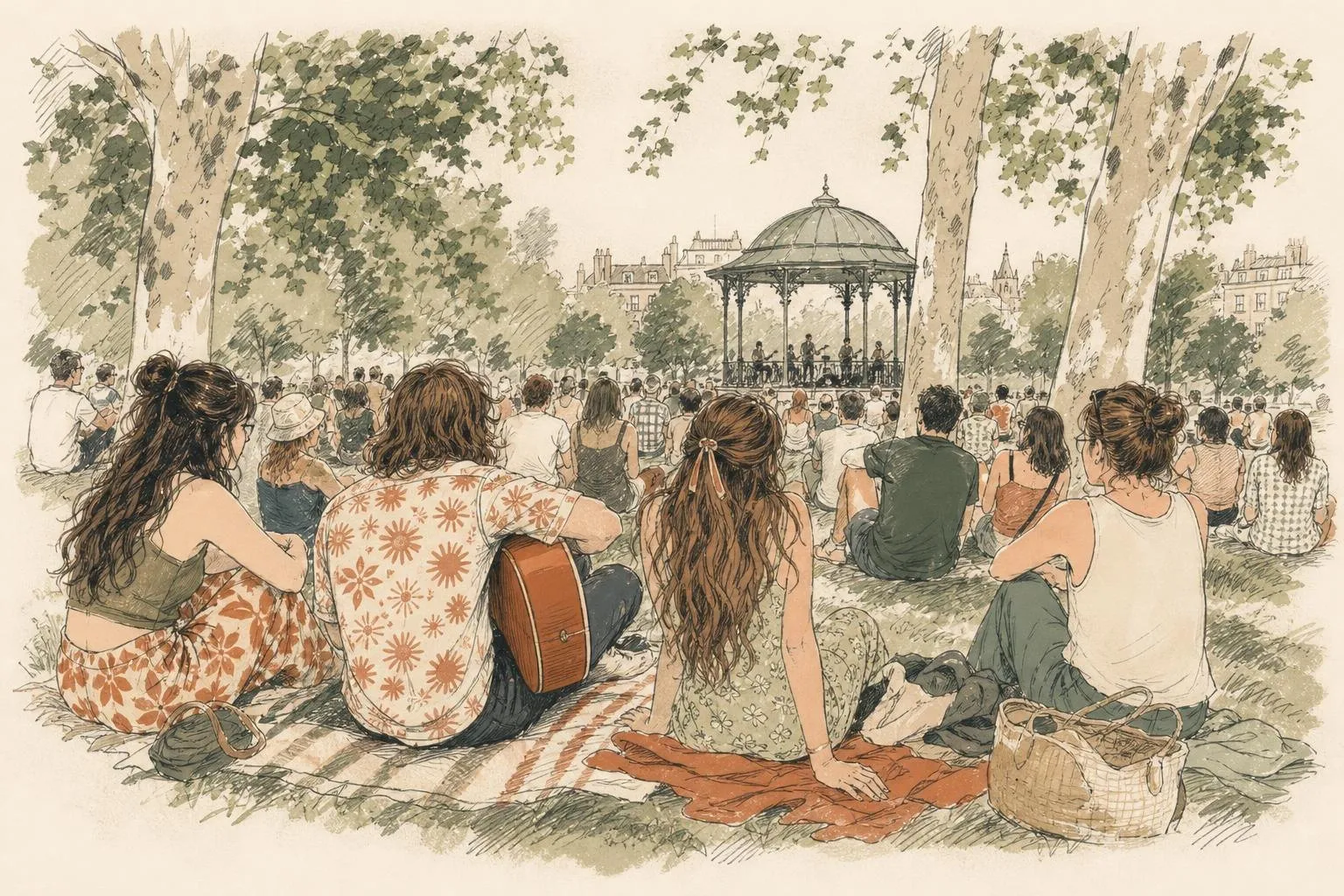
That distance is where a reportage artist has an advantage. A pen is not intrusive. A draughtsman can sit on the grass at the edge of a gathering for an hour and be taken for one more person with a sketchbook, and by the end of that hour the sitters have forgotten about him. What remains of hippies in London, drawn this way, is a record of posture, dress and mood that has none of the staging of a press shot.
Topolski and the counterculture drawings
Feliks Topolski was around sixty when the scene reached its height, a Polish-born artist who had settled in London in 1935 and had been drawing it for three decades. His Chronicle ranged from hippies and punks to royalty and politics, a new multicultural and contradictory Britain seen at street level. The memoir panorama he began painting in 1975 reaches back over the same decades, and a subject like this one, a gathering rather than a single figure, suits the way he worked: drawn in numbers, face by face.
Topolski’s Chronicle was published from 1953 until the late 1970s or early 1980s, twice a month and often in combined numbers, and its pages ran from state occasions to street life. That range explains why the counterculture sits comfortably inside his work: he treated the Albert Hall and the park bench as equally worth drawing. The artist biography outlines the wider career and the Chronicle overview shows what the broadsheets contained.
Hyde Park, 1969: the last big gathering
By the end of the decade the scene had moved into the open. Free concerts in Hyde Park drew very large crowds in the summer of 1969: Blind Faith played on 7 June, and the Rolling Stones performed on 5 July, two days after the death of Brian Jones, in front of an audience estimated in the hundreds of thousands. The Theatres Act of 1968 had ended stage censorship, and the musical Hair opened in London that September, bringing a version of the counterculture to the West End.


By then London’s hippies were a mixed population of musicians, students, squatters, travellers and the curious. For an artist, the open-air events were easy to draw because everyone was seated and in no hurry. They were also the last time such a mixed crowd would sit together without a stage between them.
Where the underground records are today
Much of what survives from the London underground is paper, and it sits in public collections. The Royal Albert Hall archive keeps a programme and a photograph from the 1965 reading, according to its catalogue, and the Bishopsgate Institute in the City holds the Hoppy Hopkins Archive, the papers of the photographer and organiser who co-founded International Times with Barry Miles in 1966. The Victoria and Albert Museum has a 1967 poster supplement to International Times designed by Michael English, museum number S.25-1978, which can be viewed by appointment at V&A East Storehouse in Queen Elizabeth Olympic Park. The Order an Object service is free, takes up to five objects per booking and needs at least two weeks’ notice, and single objects are sometimes reserved, so check the record before planning a visit.
For the drawings, the University of Utah’s digitised run of the Chronicle is the most direct route to what Topolski printed in these years, and the biography page lists the British collections that hold his other work.
Where to go next
The preceding chapter covers America in the 1960s, where the same decade took a more confrontational turn. The overall sequence of the memoir is on the memoir overview. To try the discipline yourself, the guide to reportage drawing suggests a simple routine: pick a park on a sunny weekend, sit at the edge of a group, and fill one page with the people nearest to you before you look at the ones further away.
FAQ
Questions, answered
01Where did London's hippie scene gather?
Before 1967 the centres were small: the Indica bookshop in Mason's Yard, the UFO club off Tottenham Court Road, and a few clubs and flats. After 1967 the scene spread to the King's Road, Portobello Road and Notting Hill, and in summer it met in Hyde Park, where free concerts drew very large crowds.
02Who read at the 1965 Royal Albert Hall poetry reading?
The Royal Albert Hall's catalogue lists Allen Ginsberg, Lawrence Ferlinghetti, Gregory Corso, Adrian Mitchell, Christopher Logue, Ernst Jandl, Michael Horovitz and Pete Brown among seventeen poets, with a recording of William S. Burroughs and the guitarist Davy Graham. Andrei Voznesensky was present but was forbidden by the Soviet authorities to perform. The evening ran for about four hours.
03What was the 14 Hour Technicolor Dream?
It was an all-night benefit event held at Alexandra Palace in north London on 29 April 1967, raising money for the underground newspaper International Times after a police raid. Bands, poets, films and light shows ran from evening until the next morning, and it is often treated as the peak of the London underground.
04Did Topolski draw hippies?
Yes. Accounts of his Chronicle list hippies among its subjects, alongside punks, the Black Panthers and royalty, and he lived and worked in London throughout the decade, so the counterculture was within easy reach of his studio on the South Bank.
05Why was 1967 a turning point?
That year saw the Alexandra Palace event, the Rolling Stones drug arrests, a Times advertisement calling for the cannabis laws to be reconsidered, and the Hyde Park pot rally. The press gave the scene a name, and from then on it was watched, copied and sold as much as lived.
06How do you draw a crowd without posing anyone?
Fix one patch of ground, draw the first figure you see and add neighbours as they settle, leaving gaps where people move. Use a soft pencil and accept that faces will be partial. The reportage drawing guide on this site lists materials and a short warm-up.