Reportage drawing guide
Reportage Drawing: What Is It, Which Techniques and Which Artists
Reportage drawing records a real place and real events by drawing on the spot. This guide covers the history, the on-location techniques, a light kit and exercises you can try this week.
Reportage drawing: what is it?
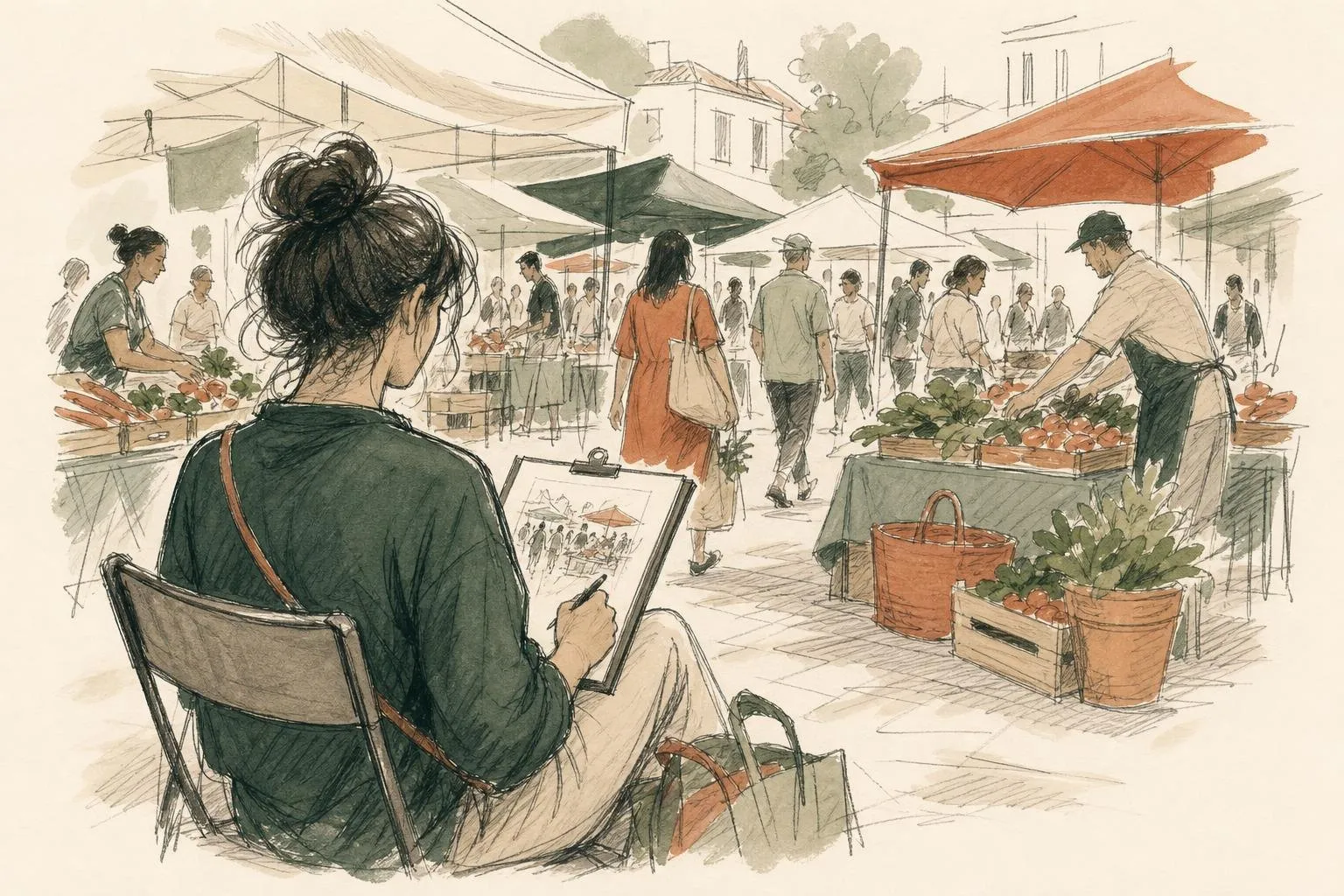
Reportage drawing is drawing as eyewitness. The artist goes to a place, whether a courtroom, a market, a polling station or a street demonstration, and draws what is there while it is there. The drawing is made at the scene, not afterwards from memory or from a photograph. Because of that, a reportage drawing carries information a photograph often cannot: what the artist chose to notice, how the room felt, who stood close to whom. It sits between journalism and art, and it is a useful discipline for anyone who wants to draw people and places quickly.
So what is reportage drawing in practice? It is a handful of habits. Draw on location. Draw at the speed of events. Accept the mistakes that speed produces. Note the date, the place and anything said or overheard, because the text is part of the record. And finish by looking at the sheet as a document: does it tell a stranger what happened? The techniques further down this page are those habits made practical.
A short history: from engravers to war artists
Drawing as reporting is older than photography. Before cameras could freeze movement, illustrated newspapers sent artists to record events and engravers turned the sketches into prints. The Illustrated London News, founded in 1842, used drawn reports of ceremonies, disasters and wars. Constantin Guys drew the Crimean War for that paper, and Winslow Homer made drawings of Union army life during the American Civil War for Harper’s Weekly. Their work was published within days of the events.
The twentieth century added official war artists. In Britain, a scheme during the Second World War sent painters and draughtsmen to the fronts and to the home front, and Henry Moore’s drawings of people sheltering in the London Underground during the Blitz are among the best known results. Edward Ardizzone, also an official war artist, drew soldiers and civilians with a fluent, humorous line. Feliks Topolski, who worked in the same period, covered the Blitz, northern Russia, India, Burma and China, and the end of the war in Europe. His life is outlined on the biography page, and the Memoir chapters, starting with The London Blitz, show how his reporting turned into large paintings.
Courtroom drawing is the most familiar surviving form. British law bars photography in courts, so news organisations have long hired artists to draw defendants, witnesses and lawyers from the public gallery, usually from memory, because sketching in court is restricted. After the war, Topolski made his own printed newspaper of drawings, Topolski’s Chronicle, which shows reportage as a publishing form in its own right.
Types of reportage drawing
Reportage covers several kinds of work, and each one changes the rules. A court artist and a festival sketcher both draw what they see, but one works from memory under legal limits while the other may sit on the front row with a box of paints. The table sets out the main types.
| Type | Where it happens | Who uses the drawings | The main constraint |
|---|---|---|---|
| Courtroom | Criminal and civil courts, inquiries | Newspapers and broadcasters | No sketching in the courtroom itself in England and Wales, so the drawing is made from memory |
| Conflict and crisis | Front lines, camps, disaster zones | Newspapers, charities, museums | Safety, and the trust of the people being drawn |
| Documentary and social | Workplaces, hospitals, streets, communities | Books, magazines, community archives | Time: a story is built over days or weeks of visits |
| Live event drawing | Conferences, rehearsals, festivals, meetings | The organisers, often within the day | Speed: the sheet has to make sense before the event ends |
| Travel and city sketching | Streets, cafes, transport | Mostly the artist, shared online | Weather, light and where you can stand |
Courtroom drawing in England and Wales
Court drawings look as if they were made in the room, but in England and Wales they usually are not. Section 41 of the Criminal Justice Act 1925 makes it an offence to take a photograph or make a sketch in court for publication, and the courtroom includes the building and its precincts. So the court artist watches, memorises faces, clothing and the layout of the dock, and then draws outside, often against a tight broadcast deadline. Some artists jot written notes in court and work them into a picture afterwards.
Cameras have only recently been allowed in at all. Since July 2022, the sentencing remarks of senior judges in the Crown Court can be broadcast, but the camera stays on the judge. Defendants, witnesses, jurors and victims are not filmed, which is why the court artist is still the only way most readers see the people in a trial.
Reportage artists to study
Some practitioners work in print, some in books, some on the street.
Joe Sacco reports from conflict zones in comic form and shows how drawing can carry testimony and interview across a long narrative. Olivier Kugler draws and writes about refugees, communities and workplaces, building his pictures from drawings made on site alongside photographs and interviews. Lucinda Rogers, a London illustrator, draws the city’s streets, markets and restaurants on location, and her work is a good model for anyone who wants to draw their own neighbourhood. Urban Sketchers, an international network that began in 2007 as an online group started by the Seattle illustrator Gabriel Campanario and became a non-profit in 2009, puts its first principle simply: “We draw on location, indoors or out, capturing what we see from direct observation.” It publishes drawings made on location by members in hundreds of cities and runs local groups, including in London, where beginners are usually welcome to join a sketch walk.
Landmarks of British reportage drawing
| Year | Artist | What they drew |
|---|---|---|
| 1916 | Muirhead Bone | Appointed Britain's first official war artist, sent to the Western Front |
| 1940‑45 | Edward Ardizzone | Full-time official war artist from the retreat to Boulogne to the Middle East; came home with almost 400 works, most now at the Imperial War Museum |
| 1942‑45 | Ronald Searle | Drew in secret as a prisoner at Changi and on the Burma railway, later published as To the Kwai and Back (1986) |
| 1982 | Linda Kitson | The only official war artist with the Falklands Task Force; more than 400 drawings in about ten weeks |
| 2013 | George Butler | Overall winner of the V&A Illustration Awards for drawings made in Azaz, Syria |
| 2015 | Olivier Kugler | Overall winner of the AOI World Illustration Awards for Waiting State, about Syrians in Iraqi Kurdistan |
Paul Hogarth, whose travel drawings set a standard for illustrators after the war, was elected a Royal Academician in 1984. In education, the Reportager project at the University of the West of England publishes an online journal and runs an award for reportage illustration, and since 2013 a residency linked to the Topolski Studio has given young illustrators the chance to work in Topolski’s tradition.
Looking at artists with different habits is useful. Moore’s shelter drawings are slow and dense, Ardizzone’s are light, and Topolski’s are fast and nervous. None of them is the one correct style of reportage.
Techniques for drawing on location
The techniques are simple, and most of them are about managing time.
Start with gesture
Begin with thirty-second drawings of anything that moves. A figure becomes an oval for the head, a slanted line for the spine and a few angles for arms and legs. These drawings are not meant to be kept. They warm the hand and teach the eye to see action before detail.
Choose a frame and a vantage point
Decide where you will stand before you pick up the pen. A corner with a view of both the crowd and the entrance usually offers more than the middle of the room. Leave space around your first figures: a scene fills quickly, and a crowded edge looks cramped.
Draw in layers
Block in the main shapes first, then add the people who stay still, such as a stallholder or a person in a queue. Add the moving figures last, using the gesture drawings you already made. If someone leaves, keep the figure you have rather than starting again.
Write on the drawing
Put a short note at the corner: place, date, weather, a phrase you overheard. Reportage artists treat notes as part of the work. Months later, the words will bring the scene back better than the drawing alone.
Do not redraw
Topolski described his approach as drawing in action and not redrawing. You do not have to copy his rule exactly, but it is a good one for practice, because it trains you to commit. If a drawing fails, start a new sheet.
A light kit for the street
A small kit is more useful than a large one because you will actually carry it. One pocket sketchbook that opens flat, one pen with waterproof ink, one soft pencil or a water-soluble pencil, and a brush pen for quick darks cover most situations. A clipboard helps when standing, and a folding stool changes how long you can stay. Keep everything in a bag you can open with one hand. More advice on carrying and using a book in public is in the guide to keeping a pocket sketchbook.
Exercises to build the habit
- Draw a bus stop for ten minutes, adding each person who arrives. Do not remove anyone who leaves.
- Spend one hour in a cafe and fill a page with six small drawings of different tables, each with its own caption.
- Pick a street and draw the same corner three times at different hours. Compare what changed.
- Draw a meeting, a talk or a community event as a sequence of panels, one per speaker.
- Return to a scene a week later and draw it again from a different angle.
If drawing figures from life still feels hard, a few sessions of life drawing build the speed and confidence you need on the street. Your first session explains what to expect.
Election and community projects
Reportage has often been a group activity. Artists have organised themselves to cover a general election campaign, a local council vote or a festival, drawing events as they happen and publishing the results quickly, sometimes as a printed broadsheet within days. Others have worked with communities, drawing with residents about their own neighbourhoods and producing a shared record. Both formats follow the older model of the newspaper drawing: a team, a deadline, a clear subject and an audience that includes the people drawn.
For a small version of the idea, pick a local event and agree a short schedule with a few friends. Each person draws at the event for one hour, adds notes, and the group meets afterwards to arrange the sheets on a table. Photocopy the lot and fold it into a simple zine.
Common problems and fixes
Beginners meet the same obstacles. The first is the blank page: the scene is too big and nothing seems worth drawing. Fix it by choosing one person or one object and drawing only that for two minutes. The second is the audience. People watch you draw and you feel exposed. Most onlookers are friendly and curious, and a quick smile and a willingness to show the page usually ends the conversation. The third is weather and light. A cold hand draws badly, so pick a spot with some shelter and keep sessions short in winter. The fourth is overworking. If a drawing is getting heavier and darker, stop and turn the page.
A fifth problem is deciding what counts as a good result. In reportage, a good drawing is one that records something true about the moment, even if the proportions are off. Look back at old sheets after a month. The drawings that still evoke the place are the ones to learn from, and they are rarely the neatest ones.
Reportage drawing or urban sketching?
The two overlap, and many people do both. Urban sketching is the larger movement and the easier way in, with local groups that meet for free. Reportage asks for a subject with a story and usually for words on the page. A useful test is the question a stranger would ask of the drawing. If it is “where is this?”, it is probably an urban sketch. If it is “what happened here?”, it is reportage.
| Reportage drawing | Urban sketching | |
|---|---|---|
| Main aim | Record an event or a story for someone else | Record a place and the pleasure of drawing it |
| Typical subject | People doing something: a trial, a protest, a shift at work | Buildings, streets, views, the sketcher's own day |
| Words on the sheet | Often essential: quotes, names, times | Optional: a date and place is usual |
| Usual output | A series, published in print or online | A single page in a sketchbook |
| Who decides the subject | Often an editor or a client | The person drawing |
Working as a reportage illustrator
Paid reportage work is real but rarely full time, and most practitioners mix it with editorial illustration or teaching. The commissions that come up most often are newspaper and magazine features, live drawing at conferences and meetings, documentation for charities and public bodies, and books. Charities commission artists to draw projects where photography would be intrusive, and Olivier Kugler’s work with Médecins Sans Frontières is a well-known example.
A portfolio for this kind of work is a set of finished series, not single pictures. Editors want to see that you can cover a whole event, from the arrivals to the last speech, and still hand in a coherent set of drawings. Three or four series of eight to twelve drawings, each about a different place or situation, say more than a large file of individual sketches.
Courses help with the discipline of working to a brief. Kingston School of Art lists a short course called Reportage Drawing: the City, and the Reportager project at the University of the West of England publishes reportage and runs events and residencies. Local Urban Sketchers groups are the cheapest way to get regular practice on location.
Books on reportage drawing
A short reading list covers the field from history to practice:
- Reportage Illustration: Visual Journalism by Gary Embury and Mario Minichiello, a survey of the form with interviews with working artists.
- The Urban Sketching Handbook: Reportage and Documentary Drawing by Veronica Lawlor, a practical guide to telling a story on location.
- Palestine and Safe Area Goražde by Joe Sacco, for reportage at book length in comic form.
- To the Kwai and Back by Ronald Searle, the drawings he made in secret as a prisoner of war.
- The Falklands War: A Visual Diary by Linda Kitson, the official war artist’s record of the 1982 campaign.
Where reportage drawing goes next
Cameras and phones mean that reportage drawing no longer has to report news. What it gives that a photograph does not is attention over time. Ten minutes spent drawing a market stall will teach you more about that stall than a hundred snapshots. Pack a pen, choose a place, and draw the first person who sits down.
FAQ
Questions, answered
01What is reportage drawing?
It is drawing done on location, in front of the subject, to document what is happening there. The result is closer to a visual news report than a polished picture. Speed, honesty about what you saw and a note of the place and time are all part of it.
02Do you need to be good at drawing to try reportage?
No. Reportage values observation and nerve more than finish. A shaky line that records a real moment is more useful than a neat drawing copied from a photograph. Start with small sheets, short time limits and a pen, so that mistakes cost nothing.
03What materials suit reportage drawing?
A pocket sketchbook, a pen that will not smudge, a soft pencil and a small waterproof ink brush pen cover most situations. Add a clipboard or a hardback sketchbook if you will be standing. Keep everything in one bag so you can start in seconds.
04Is it fine to draw strangers in public?
In most public places in the UK you can draw people you can see. Be discreet, be willing to stop if someone objects and avoid drawing children in a way that could worry a parent. Rules differ inside private premises and at some events, so ask first there.
05How long should a reportage drawing take?
Anything from thirty seconds to an hour. Many practitioners work in layers: a few quick gesture drawings first, then one longer sheet once they know where the scene is going. Time limits help because they force choices about what to leave out.
06Can you sketch in a courtroom in the UK?
Not in England and Wales. Section 41 of the Criminal Justice Act 1925 bans taking photographs or making sketches in court for publication, so court artists memorise the scene and draw outside the courtroom. Some make written notes in court and turn them into a drawing afterwards.
07What is the difference between reportage drawing and urban sketching?
Urban sketching records a place, usually for the pleasure of drawing it. Reportage records an event or a story for other people to read, so it tends to show people doing something and often includes quotes, names and times on the sheet. Many artists do both.