Chapter, 1945 and after
Belsen and Nuremberg in 1945: Witnessing the Camp and the Trials
In April 1945 Feliks Topolski reached Bergen-Belsen, two weeks after its liberation. Later he drew the proceedings at Nuremberg. This chapter sets out the history and the limits of what drawing could do.
Published
camp and trial figures, the Belsen trial, artists' works and visitor details checked on
- Belsen liberated
- 15 April 1945
- Topolski's visit
- Two weeks later, April 1945
- Nuremberg trial opened
- 20 November 1945
- Verdicts
- 30 September and 1 October 1946
Bergen-Belsen in April 1945
Bergen-Belsen lay in north-west Germany, near Celle. It began as a prisoner-of-war camp and was later turned into a concentration camp, and in the final months of the war it became a destination for prisoners moved out of other camps as the Allied armies closed in from east and west. From the end of 1944, transports arrived in growing numbers. Food, water and shelter had broken down, and typhus spread through the huts.
British troops entered the camp on 15 April 1945. They found more than fifty thousand survivors, many of them gravely ill, and thousands of unburied bodies. Medical teams, army units and relief workers set about treating the living and clearing the dead, but the condition of the prisoners was so poor that more than 13,000 died in the weeks after liberation. The scenes were recorded by army film crews and photographers, and the broadcasts and newsreels that followed forced the British public to understand what the camps contained.
The camp grew fastest in its last months. According to the Holocaust Memorial Day Trust, its population rose from about 7,300 in July 1944 to more than 90,000 by April 1945. Counts of the prisoners found on 15 April differ a little: the Trust gives around 53,000, the United States Holocaust Memorial Museum about 55,000. Totals for the dead differ more. The museum gives about 50,000 for the camp complex, most of them Jews, while the Trust gives more than 70,000. Anne Frank and her sister Margot were among those who died there, of typhus, in February or March 1945.
The BBC correspondent Richard Dimbleby entered the camp in the days after liberation. His report survives in the BBC archive, and the Trust links to the recording with a content warning.
Belsen and Nuremberg are linked in the record of 1945 and 1946 as the camp and the court. This is the context in which an artist arrived. Topolski visited Bergen-Belsen about two weeks after liberation, in April 1945, with Polish forces. The war had not yet ended in Europe, and the camp was still being cleared. The subject is difficult and does not need to be dwelled on here: the historical record, from survivors, from the liberating troops and from the later trials, is the right place for detail, and several museums in Britain and abroad provide it with care.
Key dates: Belsen and Nuremberg
| Date | What happened |
|---|---|
| 1940 | Belsen opens as a prisoner-of-war camp; the SS takes it over in 1943 |
| Feb - Mar 1945 | Anne and Margot Frank die of typhus in the camp |
| 15 Apr 1945 | British 11th Armoured Division enters the camp: about 55,000 prisoners and thousands of unburied dead |
| Apr - Jun 1945 | More than 13,000 former prisoners die after liberation |
| 21 May 1945 | The last hut is burned to stop typhus |
| 8 Aug 1945 | The London Charter sets up the International Military Tribunal |
| Autumn 1945 | The Belsen trial at Lüneburg: 45 tried, 11 sentenced to death |
| 20 Nov 1945 | The trial opens at Nuremberg: 24 indicted, 22 tried |
| 13 Dec 1945 | Kramer and the other condemned Belsen staff are hanged at Hamelin |
| 1 Sep 1946 | Hearings at Nuremberg end after about nine and a half months |
| 30 Sep - 1 Oct 1946 | Verdicts: 12 death sentences, 7 prison terms, 3 acquittals |
| 16 Oct 1946 | Executions; Göring had killed himself the night before |
| Dec 1946 - Apr 1948 | Twelve further trials at Nuremberg before US military tribunals, 185 defendants |
| 1951 | The Belsen displaced persons' camp closes |
What drawing could add to the record of 1945
By April 1945 the camp had already been photographed and filmed. A reasonable question is why an artist’s visit should matter at all. In Topolski’s case, the answer lies in the medium. A drawing is made slowly and by one person, and it records a single viewpoint at a single hour. His sheets of the camp were shown at the Ben Uri gallery in London in 1947, and they sit beside the film and photographs without replacing them, as the work of an artist aware of what a pencil can and cannot hold in front of events that seemed beyond belief.
The visit sits within a larger account of the century that he later set out in his panorama, discussed on the page for the memoir index, where a single episode is one scene among hundreds. A drawing made from life is always a record of someone present, and in 1945 that presence was a form of testimony: the artist as one more person who could say that he had been there.
After liberation: survivors and the trial
The huts were burned to the ground to stop the spread of disease. Survivors were moved to a displaced persons’ camp that British troops set up in the barracks of a German military school nearby. It housed more than 12,000 Holocaust survivors and stayed open until 1951.
The camp staff were tried separately from the leaders at Nuremberg. In the autumn of 1945 a British military tribunal sat at Lüneburg to hear what became known as the Belsen trial. According to the United States Holocaust Memorial Museum, 48 people were charged, 37 SS personnel and 11 prisoner functionaries, and 45 stood trial, three being found unfit for medical reasons. Eleven were sentenced to death, among them the commandant, Josef Kramer. Nineteen received prison terms of between one year and life, 14 were acquitted, and one man was too ill to be sentenced. Kramer and the others condemned with him were hanged at Hamelin on 13 December 1945.
Other war artists at Belsen
Topolski was one of several artists at the camp that spring. Doris Zinkeisen arrived in April 1945 to record the work of the Red Cross, and her oil painting Human Laundry, Belsen: April 1945 is in the collection of Imperial War Museums. It shows the cleansing station set up against typhus, where captured German doctors and nurses shaved, bathed and dusted former prisoners with anti-lice powder before they went on to an improvised hospital.
One of Topolski’s own camp images is in London today. The Ben Uri Collection holds a print titled Camp Guards and Inmates after Liberation, inscribed “Feliks Topolski April 1945” and cut from his Chronicle of 1960, volume VIII, numbers 1 and 2. It was presented to the collection in 2018. Fifteen years after the visit, then, he was still putting the Belsen drawings in front of subscribers, a detail that fits the wider story on the page about Topolski’s Chronicle.
The Nuremberg trials and the courtroom
Later in 1945 Topolski worked as an official war artist at the International Military Tribunal in Nuremberg. The tribunal was established by the four Allied powers, Britain, the United States, France and the Soviet Union, to try the surviving leaders of the Nazi state. It sat in the Palace of Justice, one of the few large buildings in the city to have come through the bombing in usable condition, and the first session opened on 20 November 1945.


Twenty-four men were indicted and twenty-two stood trial, and the court heard evidence for nearly a year. The charges covered crimes against peace, war crimes and crimes against humanity, and the prosecution relied heavily on the regime’s own documents, together with films and the testimony of witnesses. Verdicts were read out on 30 September and 1 October 1946. Twelve defendants were sentenced to death, three were acquitted and seven received prison terms ranging from ten years to life. Hermann Goering, one of the condemned, took his own life the night before the sentence was due to be carried out. Among those executed were Hans Frank, Alfred Rosenberg and Julius Streicher.
Hearings ran from 20 November 1945 to 1 September 1946, about nine and a half months, before the court returned to deliver its judgment. The presiding judge was the British member, Geoffrey Lawrence, with Norman Birkett as the British alternate. Proceedings were interpreted simultaneously into English, French, German and Russian, which is why the photographs show the defendants in headphones. After the main trial, American military tribunals held twelve further trials in the same city between December 1946 and April 1948, against 185 defendants.
Why Nuremberg was chosen
The choice of city was a compromise. The United States and the Soviet Union each wanted the trial held in its own zone of occupation, and at the London Conference in August 1945 the Allies agreed that the tribunal’s permanent seat would be Berlin while the first trial went to Nuremberg, in the American zone. The Memorium Nuremberg Trials gives two practical reasons. The Palace of Justice on Fürther Strasse was barely damaged and had room for four national delegations, and a prison stood directly north of it, so the defendants could be held and guarded next to the court. A wooden passage was built to bring them across. The city’s past as the venue of the Nazi Party rallies, where the race laws were announced, was not the deciding factor, but it gave the choice a symbolic weight.
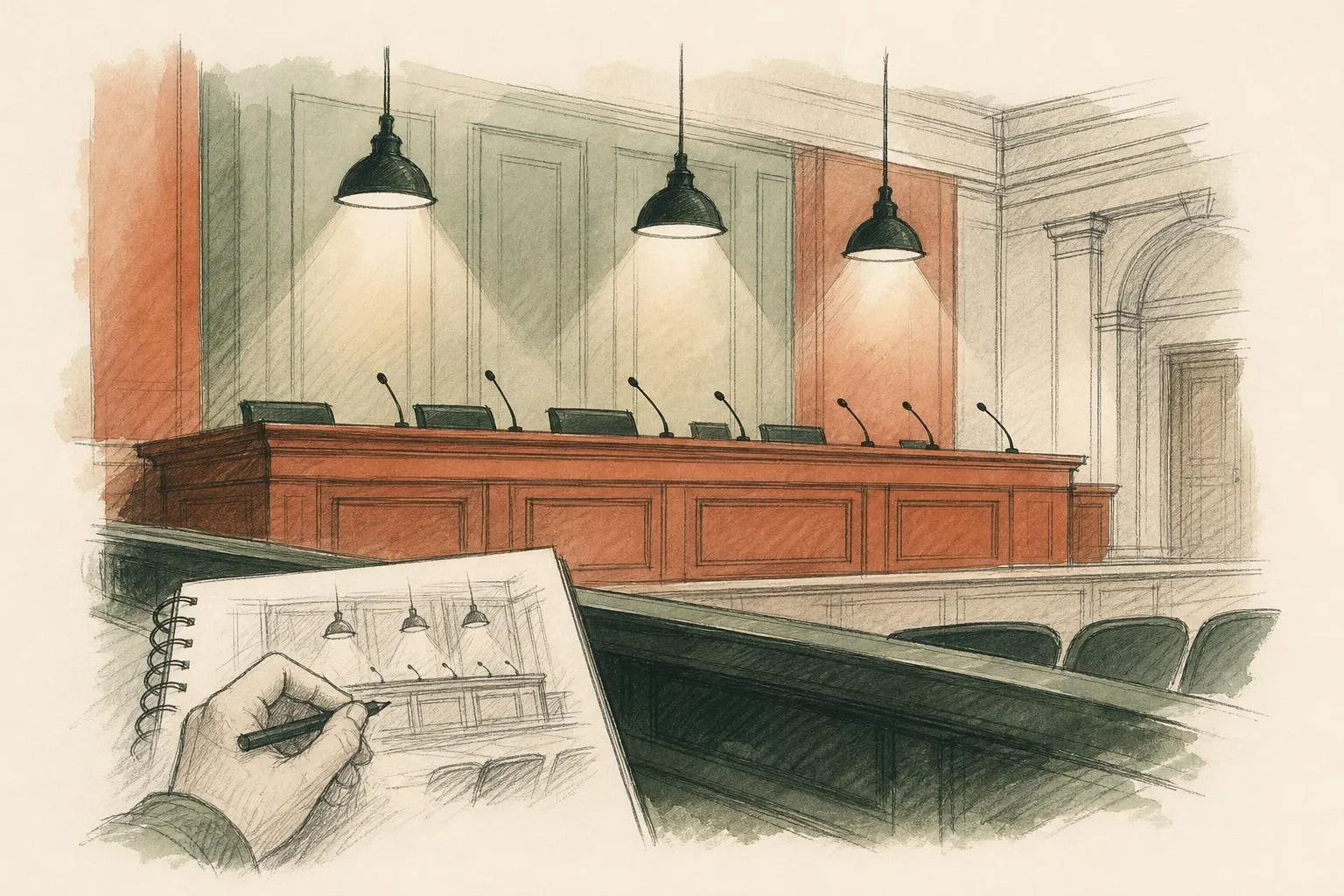
A courtroom is a restricted space, and the work of a courtroom artist depends on rules. Faces have to be caught in a few minutes from a distance, under bright light, while the proceedings move on. The skills of reportage, quick observation, a firm sense of the shape of a head and an eye for the exact moment, are the ones that were most useful in the gallery at Nuremberg. A courtroom sheet of this kind is a study of posture and attention: who leans forward, who looks away, who sits perfectly still while the translation comes through the headphones.
Laura Knight in the press gallery
The best-known painting of the courtroom is by another British artist. Laura Knight went to Nuremberg as a war correspondent and sketched the main figures from a gallery above the dock. Her oil The Nuremberg Trial, 1946, now at Imperial War Museums, shows the defendants in their headphones, with the ruined city breaking into the room around them. Two chalk and watercolour studies for it, Nuremberg Trials 1946 Study No. 1 and No. 2, are on long-term loan to the Ben Uri Collection in St John’s Wood, the same London institution that showed Topolski’s Belsen drawings in 1947. Knight worked her sketches up into one large canvas. Topolski’s courtroom work stayed closer to the quick sheet made on the spot.
Sequence, family and the wider panorama
Topolski’s war years were also a family story. He married Marian Everall, and they had a daughter, Theresa, and a son, Daniel. His portrait subjects included the writer H. G. Wells, whose portrait of 1943 is now in the National Portrait Gallery. Set beside the camp and the courtroom, those portraits are a reminder that reportage is not a sealed genre: the same hand that drew the tribunal drew writers and relatives. The biography follows the arc of that life, and the page on reportage drawing explains how the tradition of drawing on the spot was shaped by assignments like these.
Visiting Belsen and Nuremberg today
Both places can be visited, and two London collections hold related works. The details below were checked on the venues’ own sites; times change, so check again before you travel.
| Place | Where | What to know |
|---|---|---|
| Bergen-Belsen Memorial | Anne-Frank-Platz, Lohheide, Lower Saxony | Free entry. Documentation centre daily 10:00-18:00 (April to September) and 10:00-17:00 (October to March), closed over the Lower Saxony Christmas holidays; grounds open every day |
| Memorium Nuremberg Trials | Top floor of the Palace of Justice, Nuremberg | Courtroom 600 is part of the exhibition but can close for court events, so check its closing dates |
| IWM London | Lambeth, south London | Free entry. The Second World War and Holocaust Galleries opened on 20 October 2021 |
| Ben Uri Collection | 108a Boundary Road, St John's Wood, London | Holds Topolski's Belsen print and Knight's Nuremberg studies; ask what is on view |
Both London collections are free to enter, and the page on free museums in London lists other places in the city where you can look and draw.
Belsen and Nuremberg in the sequence
Taken together, Belsen and Nuremberg close the war narrative. The chapter that precedes this one, on the last year of the war, follows Topolski through Italy and into Germany as the fighting ended. The one that follows, on post-independence India, moves to 1949 and 1950, when he returned to a country he had known during the war and drew its first years as an independent state.
If you want to understand how the proceedings looked at the time, the most reliable route is to read the published trial record, which is available online in full, and then to look at drawings from the courtroom. Reading first gives the images a framework. It also makes plain how much of the work of a tribunal is documents and testimony, and how little of it can be shown in a single sketch.
FAQ
Questions, answered
01When was Bergen-Belsen liberated?
British forces entered the camp on 15 April 1945. They found tens of thousands of survivors, many gravely ill, and thousands of unburied dead. Despite medical efforts, more than 13,000 people died in the weeks after liberation, mostly from disease and starvation.
02Did Topolski draw at Belsen?
Yes. In April 1945 he travelled with Polish forces to Bergen-Belsen, arriving about two weeks after liberation, and his drawings of the camp were later shown in London at the Ben Uri exhibition Subjects of Jewish Interest in 1947. The sheets belong to the wider record of the camp, which survivors, soldiers and film crews documented in far greater detail.
03What were the Nuremberg trials?
The International Military Tribunal opened in the Palace of Justice at Nuremberg on 20 November 1945. Twenty-four leaders of the Nazi regime were indicted and twenty-two tried, and the verdicts were delivered on 30 September and 1 October 1946. Twelve were sentenced to death, one of them in absentia, seven received prison terms and three were acquitted.
04Why did the Nuremberg trials matter?
They set out, in a public court with documentary evidence, the charges of crimes against peace, war crimes and crimes against humanity, and they shaped later international law. The documents and testimony remain a primary source for the history of the Holocaust.
05What was the Belsen trial?
It was the trial of the camp's staff, held before a British military tribunal at Lüneburg in the autumn of 1945. Of 48 people charged, 45 stood trial. Eleven were sentenced to death, including the commandant Josef Kramer, 19 received prison terms and 14 were acquitted. The executions took place at Hamelin on 13 December 1945, months before the Nuremberg verdicts.
06Can you visit Bergen-Belsen today?
Yes. The Bergen-Belsen Memorial at Anne-Frank-Platz, Lohheide, in Lower Saxony, is free to enter. The documentation centre opens daily from 10:00 to 18:00 between April and September and from 10:00 to 17:00 between October and March, and the grounds are open every day. Check the memorial's own site for holiday closures before you go.