Memoir chapter
1960s America: Civil Rights and the Drawings Topolski Made on the Road
The 1960s in the United States moved from the Kennedy campaign to the Chicago riots in under nine years. This chapter follows that decade and the drawings a visiting reportage artist made inside it.
Published
Selma march figures, the 1956 and 1968 convention cities and the Chicago 1968 figures checked on
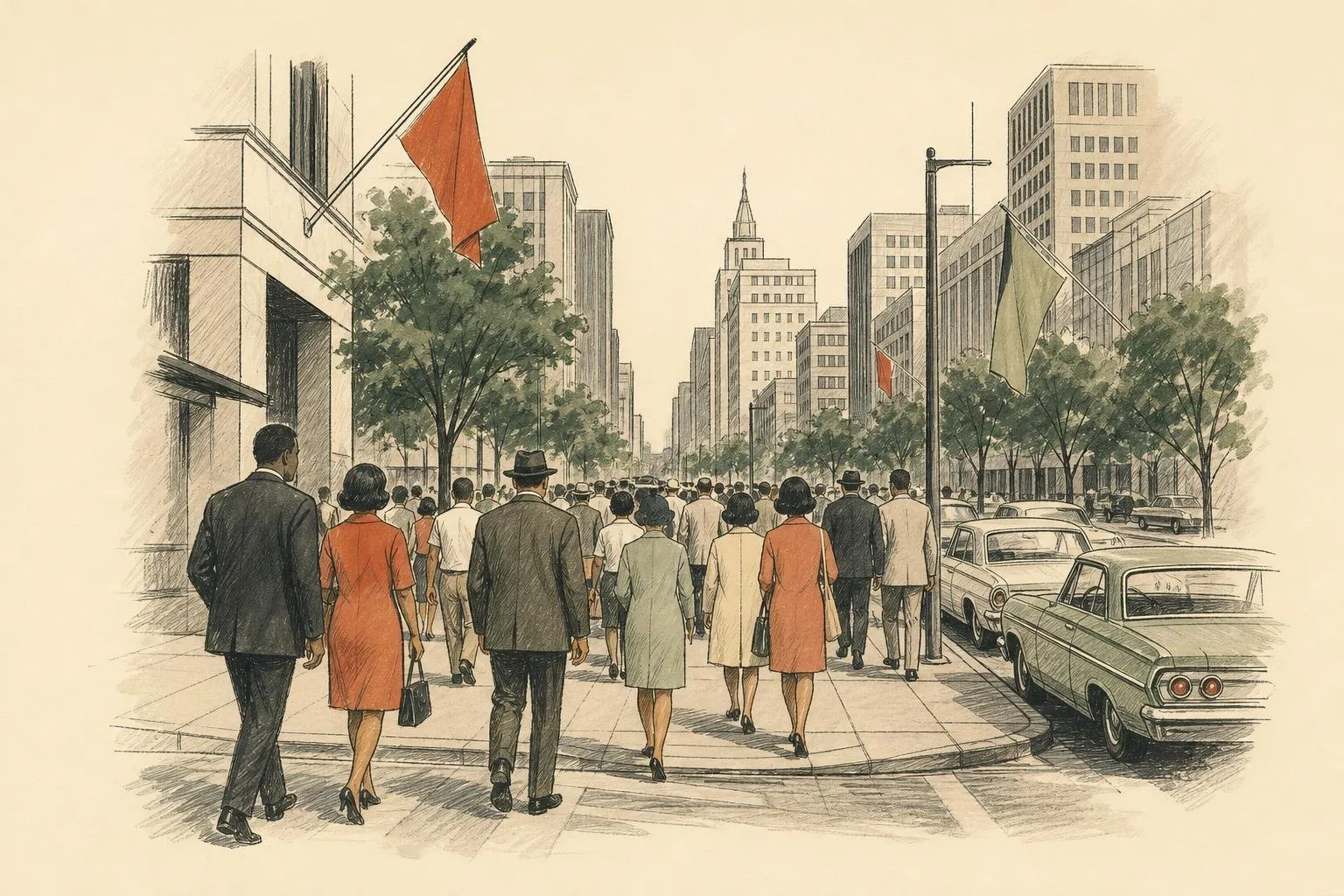
- March on Washington
- 28 August 1963
- Voting Rights Act
- 6 August 1965
- Chicago convention
- 26-29 August 1968
- Earlier US work
- CBS conventions, 1956
From the Kennedy campaign to 1963
The decade opened with a close presidential election. John F. Kennedy, aged 43, won in November 1960 and brought a new style to Washington, with televised press conferences, a young family and an appeal to a generation born in the twentieth century. The rhetoric ran well ahead of the law at home. Segregation in the South was still enforced by statute: the Greensboro lunch-counter sit-ins began in February 1960, the Freedom Riders were attacked in 1961, and in the spring of 1963 the campaign in Birmingham, Alabama, was met with dogs and fire hoses.

The March on Washington on 28 August 1963 brought around a quarter of a million people to the Lincoln Memorial, where Martin Luther King spoke. Kennedy was killed in Dallas less than three months later, on 22 November 1963, and the Civil Rights Act was signed in July 1964 under Lyndon Johnson.
Key dates of 1960s America
| Date | What happened |
|---|---|
| Aug 1956 | Democrats meet in Chicago, Republicans at the Cow Palace, San Francisco; CBS sends Topolski to draw both |
| 1 Feb 1960 | The Greensboro sit-ins begin |
| 28 Aug 1963 | March on Washington, about 250,000 people; "I Have a Dream" |
| 22 Nov 1963 | President Kennedy is assassinated in Dallas |
| 2 Jul 1964 | The Civil Rights Act is signed |
| 7 Mar 1965 | "Bloody Sunday" on the Edmund Pettus Bridge, Selma |
| 21-25 Mar 1965 | The Selma to Montgomery march covers 54 miles to the Alabama State Capitol |
| 6 Aug 1965 | The Voting Rights Act is signed |
| 4 Apr 1968 | Martin Luther King is assassinated in Memphis |
| 26-29 Aug 1968 | Democratic National Convention, Chicago |
| 1 Dec 1968 | The Walker Report, Rights in Conflict, is published |
Civil rights: Selma and the vote
In 1965 attention moved to Alabama. Marchers setting out from Selma on 7 March were beaten at the Edmund Pettus Bridge, an event known as Bloody Sunday that was broadcast across the country. President Johnson signed the Voting Rights Act into law on 6 August 1965. On 9 March, two days after Bloody Sunday, King led about 2,500 marchers back to the bridge and turned them round at police instruction. The march that succeeded left Brown Chapel in Selma on 21 March with about 8,000 people, guarded by 2,000 National Guard troops and federal marshals, and reached the Alabama State Capitol in Montgomery on 25 March. Estimates of the crowd at the capitol run from 25,000 to 30,000, and even the Encyclopedia of Alabama gives both figures. The 54-mile route is now a National Historic Trail run by the National Park Service, running from Brown Chapel over the Edmund Pettus Bridge to the Alabama State Capitol in Montgomery.
In the same year Malcolm X was shot dead in New York on 21 February, a few weeks before the Selma crisis.


Topolski’s Chronicle, the broadsheet he published from his studio from 1953, carried America in these years. Biographical accounts list portraits of Martin Luther King among his subjects, a reminder that the movement’s leaders sat for him as readily as the crowds around them. A full list of what the Chronicle printed on America in these years is beyond this page, and it is the part of the story where a reader should go to the printed issues.
An artist who already knew the American stage
The decade was not his first American assignment. In 1956 CBS Television sent him to the national political conventions to record them in drawings, and the result was a book called The Blue Conventions. That commission is the best evidence for how he treated American politics: as a staged event whose staging was itself worth recording. A convention hall has a stage and a floor, and the drawings go to the floor.
The geography of that first trip matters for what came later. The Democrats held their 1956 convention at the International Amphitheatre in Chicago, and the Republicans met at the Cow Palace in San Francisco. Twelve years on, Topolski’s American journey of 1968 ran through the same two cities, from the convention riots in Chicago to the Black Panthers in the Bay Area. He came back to places he had already drawn once in calmer years.
For a draughtsman, 1960s America had the same layering, and it still rewards a slow look at the drawings of the period. The marches, the speeches and the assassinations were all heavily photographed and filmed, so what a pen could add was an angle. A drawing from the edge of a crowd records who stood next to whom, which gloves were on, which faces were turned towards the speaker and which away. The method is set out in the guide to reportage drawing.
Drawings of 1968: Chicago and San Francisco
The year 1968 was the worst of the decade. Martin Luther King was shot in Memphis on 4 April. Robert Kennedy was shot in Los Angeles on 5 June and died the next day. In the last week of August the Democratic Convention in Chicago, from 26 to 29 August, was surrounded by anti-war demonstrators and police, and the confrontation in the streets was televised live.
Topolski travelled to America that year and recorded the riots in Chicago, then went to San Francisco to meet members of the Black Panther Party, which had been founded in Oakland in October 1966. Whatever the exact itinerary, the choice of subject fits the long habit of the Chronicle: go where the argument is, and draw the people having it.
Chicago 1968 in figures
A study by the University of Wisconsin-Madison’s Nonviolence Project counts 11,500 Chicago police, 5,600 Illinois National Guardsmen, 7,500 federal soldiers and 1,000 federal agents, against an estimated 10,000 or more demonstrators. Police used tear gas to clear Lincoln Park at curfew on 25 August. On 28 August the crowd outside the Conrad Hilton Hotel on Michigan Avenue was charged in a clash lasting about 17 minutes. By the end of the week 641 people had been arrested and 63 members of the press said police had attacked them.
The official account came out on 1 December 1968. Written for the National Commission on the Causes and Prevention of Violence by a team under Daniel Walker, it was titled Rights in Conflict and described much of what happened as a police riot. Read beside drawings made in the streets that week, the report is a useful companion, because it places the worst of the violence outside the hall, among the hotels and parks where a sketchbook could go.
Reading 1960s America through a visitor’s eyes
A visiting artist is in a particular position. He arrives with a European education, a wartime record and a reputation for drawing public figures, and he sees details that residents have stopped noticing: the scale of the cars, and the size of the rooms in which decisions were made. Topolski had been naturalised as a British citizen in 1947 and was by then part of London’s art world, which gave him both access and distance.
In the sense that matters here, 1960s America was a subject that changed faster than any book could follow. The Chronicle, issued every few weeks and printed in large format, was a better fit for it than a bound volume. Each issue could carry a fresh batch of drawings from a trip while the events were still unresolved.
What the American chapters add to the memoir
The earlier sections of the memoir deal with war and its aftermath: the Blitz, Belsen and Nuremberg, the tour of post-independence India and the pageantry covered in the chapter on China and the Coronation. The American material is different in kind, because the conflict is internal and still unresolved when the drawings are made. Nobody on the page knows how it ends.
That is the strongest argument for the on-the-spot method. A later historian can write that the Voting Rights Act followed Selma. A sketchbook made in the crowd records the uncertainty beforehand. The following chapter turns to London in the same decade, where the counterculture of the hippies was taking shape, and the biography page places all of it in the longer career. For a first exercise, find any public gathering this week and draw the back of the crowd for fifteen minutes.
FAQ
Questions, answered
01Did Topolski draw the civil rights movement?
Biographical accounts list portraits of Martin Luther King among his subjects, and in 1968 he drew members of the Black Panther Party in San Francisco. Which drawings were made where, and when, is best checked in the Chronicle issues themselves, which carried much of his American work.
02What did he draw in 1968?
In 1968 he travelled to America and recorded the riots around the Democratic Convention in Chicago, then went on to San Francisco to meet members of the Black Panther Party. That year also saw the assassinations of Martin Luther King and Robert Kennedy, which frame the whole trip.
03Had he worked in the United States before?
Yes. In 1956 CBS Television sent him to the national political conventions to document them in drawings, and the result was a book titled The Blue Conventions. That earlier assignment gave him the habit of drawing inside American political theatre, which he carried into the next decade.
04What was the Walker Report on Chicago 1968?
It was the study of convention week in Chicago, published on 1 December 1968 under the title Rights in Conflict for the National Commission on the Causes and Prevention of Violence and written by a team led by Daniel Walker. It described much of the violence as a police riot, a phrase that has stuck to the events Topolski drew that summer.
05Why do reportage drawings suit conventions and marches?
Both are staged for cameras, so a pen records what the cameras skip: the delegate asleep, the marshal checking a watch, the faces at the back of the crowd. Drawing is also slow enough to force a choice, so each picture holds an opinion about where the story actually was.
06Where can you see his Chronicle drawings?
The Marriott Library at the University of Utah subscribed to the Chronicle for its whole run, keeps the collection in its Fine Arts and Architecture Library and has digitised many issues. The Memoir of the Century panorama was painted in the arches under Hungerford Bridge on London's South Bank, and its current display should be checked with the venue.